
- Home
- Tom Clancy
SSN Page 30
SSN Read online
Page 30
A war of aggression is really nothing much more than a large-scale armed robbery. Is this scenario plausible? I think it’s quite plausible. Because nations are greedy. Particularly Marxist nations.
James Adams: Doug, you served out in the Far East as a submariner. Do you agree with that? Was the potential threat posed by China part of the war game that went on when you were out there?
Captain Doug Littlejohns: I was out there in the mid ’60s. That was at the time of the Indonesia confrontation, and we didn’t really think much about China in those days.
James Adams: Would you buy the general scenario as seeing China becoming a bigger player on the scene?
Captain Doug Littlejohns: Oh, very much so. And I think this is an extremely good plot.
James Adams: Tom, you talked briefly about the Spratlys. Tell me a bit more about them. We’ve read a lot about them, and we know that many nations claim them, and I think that China has landed ships on them. And so have other countries. What exactly is the status of those islands?
Tom Clancy: The Spratly Islands are kind of like a dead grandfather with a heck of a big estate. And everybody wants to claim to be the number-one heir. In fact, I think that China’s territorial claim to the Spratlys is fictitious.
James Adams: Tenuous at best.
Tom Clancy: Especially given their location. But they’re such inhospitable pieces of real estate that whoever can get there, plant a flag, and defend it is going to own them.
James Adams: And you think that this scenario, where China is an aggressor because of political instability internally, might be a realistic driver in the near future?
Tom Clancy: Well, historically, a nation with internal problems will externalize. And nothing draws a country together like an external threat. Or a perceived external threat. It’s the classical method historically to unite a country.
James Adams: Doug, you have tremendous experience in submarines. This is a story about submarines. We’re in a post-Cold War world now. We devoted a great deal of energy to dealing with the potential threat from the Soviet submarine fleet. But now we’re in a different environment. What do you think is the strategic and tactical role of submarines in the post-Cold War world?
Captain Doug Littlejohns: It ranges right across the spectrum, starting obviously with the major strategic use of a submarine — which is to launch intercontinental ballistic missiles. But in this situation, the submarine can be used strategically by taking up a position off an enemy area. Its existence is then made known to the enemy. We had a very good example of that in the ’70s when Argentina was making noises about the Falklands. We dispatched an SSN down there, and we told them it was there. And that put off the business for a few years.
James Adams: But in that particular situation, Argentina had no counter force to combat that. They weren’t capable really of dealing with the submarines that we had. That’s not the case with China, where they have a pretty extensive anti-submarine warfare capability.
Captain Doug Littlejohns: Well, they have an anti-submarine warfare capability. I don’t think you can put it in the same league as the anti-submarine capability of NATO nations or, indeed, of the former Soviet Union. So for the game — and for reality — the technical superiority of the U.S. submarine force far outweighs the capability that China, on its own today, could put against them.
James Adams: In other words, the submarines that the Americans can field are quieter and faster than the capability of the Chinese to find with their sonars and other technologies.
Captain Doug Littlejohns: Yes. At this stage. But the world always moves on.
I think that for the scenario that we’re looking at here — which isn’t cast in today’s technological climate — the American submarines would have a pretty good time against their ASW forces.
James Adams: Tom, do you think that the Chinese Navy would have any realistic chance against the United States? They have a lot of numbers but not much capability, and there’s a huge technological gap between the two.
Tom Clancy: One of the things you have to remember about combat is that it’s not really a technical exercise. It’s a human exercise, and a psychological exercise. It’s not machine against machine, it’s person against person. And we all too often overlook that. The difference between a good navy and a bad navy is the quality in the training of its personnel. You know, better to have good men in bad ships than bad men in good ships. If the Chinese decide to make it a national goal to upgrade their Navy — and, of course, they don’t really have a Navy; it’s the Naval Branch of the People’s Liberation Army — but if they decided to really invest some time and money in it to develop the capabilities they need, they could indeed be quite formidable.
China does have a maritime history that we all too often forget.
James Adams: But they’ve been trying to upgrade land, sea, and air for some years now. They’ve invested a lot of money, and a lot of people. But they’ve not been able to bridge that technological gap between the United States and the NATO forces and what they currently have. They have a lot of things, but can they take that training and that technology and bring them together to make it effective, do you think?
Tom Clancy: The fundamental power base of any country is its economy. China has a very rapidly growing economy. They’re making computers. They’re making all manner of products, which can be sold worldwide. If they can do that, they can make damn near anything.
James Adams: So do you think that today we treat China with kid gloves that are perhaps inappropriate? Do you see them as a threat, as some people would argue, for the stability of the world?
Tom Clancy: I don’t know that I would go quite that far. Probably the country at greatest risk from Chinese aggression would be Russia, the former Soviet Union.
Do we treat China in a way which causes me difficulty? Yes. When Deng Xiaoping stomped on the demonstrators in Tiananmen Square, we should have done something, for two reasons: First of all, America should not do business with countries that do such things to its own citizens. Moreover, and this is something frequently overlooked, that act was deliberately taken in the knowledge that Bernie Shaw and CNN were filming it — or sending it out live at the time — on global television. They were, indeed, therefore telling the world, “Drop dead. This is the way we do business and if you don’t like it, that’s too bad.” I question the ethics of doing business as usual with a country that is so grossly repressive as the People’s Republic of China.
James Adams: Doug, in SSN we have a very realistic portrayal of what it’s like to be in command of a submarine. Something that you have done. Can you tell me a bit about what sort of training goes in to make a commander? What is looked for, psychologically and in practical terms, in somebody who can deliver?
Captain Doug Littlejohns: First of all, the game is designed to put the player outside the submarine, if you like, to envisage the tactical situation around him in his mind’s eye. And to have a pictorial representation of that. That is where the game is unique. Nothing like this has been done before. As for what makes a good submarine commander, that is really almost impossible to quantify properly.
James Adams: You go on a course in England called the Perisher Course, don’t you?
Captain Doug Littlejohns: Oh, yes.
James Adams: What do they make you do in that course?
Captain Doug Littlejohns: First of all, there’s a big weeding out process before you ever get to that point. Lots of people want to be submariners, but when they get there they find they don’t like the way of life or the hours they have to keep.
James Adams: What about claustrophobia?
Captain Doug Littlejohns: I’ve only ever seen one member of a submarine who suffered from claustrophobia. In the main, you just don’t experience it. Human beings are very adaptable. By the time what we call in the Royal Navy the submarine Perisher comes along, most people are well imbued into submarines. Then it’s a question of whether they’ve got both the sta
mina and the mental acuity — the particular ability to remember a tactical picture after having glanced at it only very briefly. With the submarine tossing around, maneuvering all over the place, it’s very difficult to still be able to know where the various components of that tactical picture are.
That is a particular type of spatial awareness although we didn’t have that term when I did the course.
James Adams: That is very similar to the effect in SSN, where you’re having to simulate essentially what the spatial picture looks like.
Captain Doug Littlejohns: Yes. And the player has got to be able to assimilate the information — which is not coming in as thick and fast as it does on a real submarine, but it’s reasonably realistic. If he doesn’t assimilate the information, if he can’t put things in the right priority order and tackle them in a sensible way, then he will get caught.
James Adams: Tom, Doug is a good friend of yours and has been for a number of years. You also know a number of American equivalents to Doug. What would you say is the difference between a British and an American submarine commander?
Tom Clancy: I’ve gotten into a lot of trouble on this.
Captain Doug Littlejohns: And you could get in trouble here, now.
Tom Clancy: I’ve been sufficiently propagandized by Doug and a few of his partners in crime in the Royal Navy that I once published an article suggesting that the Royal Navy trained its submarine skippers better than the U.S. Navy did. Which earned me the undying wrath of a certain senior officer in the United States Navy.
You can argue long and hard about the difference between having a specialist and a generalist. Generally speaking, I think the Royal Navy has a way of developing its officers and identifying its stars. It beats the hell out of them to winnow them out, and then it picks the absolute best of that group to command. It is able to award command at a much younger age than we do in the U.S. Navy.
I think that’s a fundamentally healthy thing.
James Adams: So would you say that implies that the British commanders tend to be younger, more aggressive, and have more initiative? Or is it that it merely comes out in a different way?
Tom Clancy: It’s well within the range of personal variances — we have good ones, they have good ones, we have bad ones, they have bad ones. Generally speaking, I would say that their method for advancing their prospective commanding officers is somewhat better than ours.
James Adams: Do you agree with that, Doug?
Captain Doug Littlejohns: Yes, I do. I’m not so sure about the “we have bad ones,” but I’ll let Tom get away with that.
To go back to something that Tom said earlier, a lot of the technical capability of the U.S. submarines is of higher quality than ours, but somehow or other we manage to achieve the same sort of results. And the two navies work very closely together. Particularly on the submarine front.
James Adams: And what about the Chinese? What do we know about how they train and perform in their navies? Do we have any sense of that really?
Tom Clancy: Well, it’s a Communist country, and the Communists do not reward personal initiative… except by execution.
Now, in Communist China, you have the odd situation where they’re trying to develop a free market economy without political freedom. And that is ultimately going to fail. Because that doesn’t work. But until such time as that happens, we do face a potential adversary, given the fact that they do have the industrial capability to produce just about anything they want, of high enough quality. If they can sell television sets throughout the world, then they can build a nuclear submarine. It’s just a matter of quality control. And if they want the oil in the Spratly Islands all that badly, which they probably do, then it’s simply a matter of establishing as a national priority to make a Navy which is competitive with the rest of the world. If they decide to do that, they can.
Historically, Kaiser Wilhelm II decided to make a Navy which was quite competitive with the Royal Navy. And they did it in, what? One generation?
Captain Doug Littlejohns: And, of course, the former Soviet Union had to go through the same transformation in the ’60s, after the Cuban Missile Crisis. They certainly needed to build up a deep water Navy. And they did that. It took them probably ten, fifteen years — not just to get the equipment, but to be able to use it to a reasonable standard.
James Adams: Yes. And they developed a very effective submarine fleet.
One of the points of this game is that we have Russia passing on some equipment to the Chinese. Do you think that’s realistic? Will the Russians sell their soul, so to speak? I mean, their submarine fleet is really the only thing that’s left of their Navy that’s effective.
Captain Doug Littlejohns: Well, they’ve sold submarines to other parts of the world.
James Adams: Most of them, though, have been pretty low-grade, old-fashioned things, right? To Iran?
Captain Doug Littlejohns: They’ve also sold nuclear submarines to India. And whether they’re potential adversaries or not, there are clearly still links there. But Tom would know more about that than me.
Tom Clancy: It’s a political and economic question. The Russians are so strapped now for hard currency that if you make them the right kind of offer, they’ll probably deliver.
James Adams: And the Chinese have enough hard currency by comparison?
Tom Clancy: We’ve got a trade imbalance in China that would buy half the Soviet Navy.
James Adams: In the same way, the game supposes that a takeover of the Spratly Islands is the beginning of a move on Taiwan. We saw the exercises off Taiwan recently, which looked very intimidating. Do you think that remains a Mainland China ambition?
Tom Clancy: It could be. The Falkland Islands War of 1982 is an interesting historical model. Why did that happen? It happened because the military junta that ruled Argentina at the time was making such a botch of running their nation that they had to find something to distract their people from the screwups they had at home. And they did that by grabbing the Falklands and causing a particularly pointless little war.
In the case of the People’s Republic of China, one way to distract their people from their political difficulties at home is to externalize. One target is Hong Kong. They’re going to absorb Hong Kong very shortly. And if they can absorb Taiwan, they’ll have an enormously powerful economy.
Also, they would put “paid” on a long-standing bill with Chiang Kai-shek and the Pao Min Tong. And the Chinese are people with long memories.
James Adams: But this would not be without cost. It would be difficult to imagine the United States sitting by and saying, “Okay, guys, take it over.”
Tom Clancy: This is unknown. It is a fact of U.S. law that America has a particularly schizophrenic policy toward China. On the one hand we acknowledge that there is only one China. And yet, on the other hand, we say this is not true. But if the People’s Republic of China attacks Taiwan, we’re not going to like it very much.
Now those two statements of policy are incompatible, but that is standing U.S. law.
Captain Doug Littlejohns: I think the world should watch very carefully what the Chinese military does now. When they did their exercises off Taiwan, they had to sort of back down. It will be interesting to see how they respond to that, and whether they feel that they’ve got to pour more money or focus more money in certain areas to ensure that that never happens again.
Tom Clancy: A further complication: What’s the nearest U.S. Navy base? We don’t have Subic Bay in the Philippines anymore. We have to stage out of the nearest one we have — which I guess is Japan. And that’s a goodly distance.
James Adams: Yes, it is. And would Japan really want that either, if China was rattling sabers?
Tom Clancy: Good question.
Captain Doug Littlejohns: They’re not terribly keen on nuclears.
Tom Clancy: No, they’re not. The next nearest fleet base is Pearl Harbor, and that’s 3,000 miles.
James Adams: Give me a sense of
what it’s like inside a submarine in a crisis. You’re under attack. You don’t quite know where the enemy is. You’ve got to find them, retaliate, and at the same time take evasive action. What’s the flavor of that like? What’s the smell, the taste of the drama?
Captain Doug Littlejohns: Well, the first thing I’d like to get across to people — and I think the player needs to get that as well — is professionalism. People remain reasonably cool and calm. They have to, to do their job, because everybody is depending on everybody else.
James Adams: It didn’t look like that in Crimson Tide, of course.
Captain Doug Littlejohns: Well… I thought Crimson Tide was a great movie until about halfway through it.
James Adams: Until their mutiny started.
Captain Doug Littlejohns: I hope that wasn’t made by Paramount.
Having said that, you train for it all the time. And therefore it’s almost — well, second nature is probably putting it too far, but if you compare a submarine to a smooth-running engine, then a little perturbation like an attack and so on just notches it up to a different gear. And people respond to that. I’ve never experienced hysteria or people jumping up and down. They just get on and do the job.
 Changing of the Guard
 Clear and Present Danger
 Hounds of Rome
 Breaking Point
 Tom Clancy's Jack Ryan Books 7-12
 Full Force and Effect
 The Archimedes Effect
 Combat Ops
 Into the Storm: On the Ground in Iraq
 Under Fire
 Point of Impact
 Red Rabbit
 Rainbow Six
 The Hunt for Red October
 The Teeth of the Tiger
 Conviction (2009)
 Battle Ready
 Patriot Games
 The Sum of All Fears
 Fallout (2007)
 Red Storm Rising
 The Cardinal of the Kremlin
 Executive Orders
 Lincoln, the unknown
 Threat Vector
 The Hunted
 Shadow Warriors: Inside the Special Forces
 End Game
 Special Forces: A Guided Tour of U.S. Army Special Forces
 Locked On
 Line of Sight
 Tom Clancy Enemy Contact - Mike Maden
 Fighter Wing: A Guided Tour of an Air Force Combat Wing
 Springboard
 Line of Sight - Mike Maden
 EndWar
 Dead or Alive
 Tom Clancy Support and Defend
 Checkmate
 Command Authority
 Carrier: A Guided Tour of an Aircraft Carrier
 Blacklist Aftermath
 Marine: A Guided Tour of a Marine Expeditionary Unit
 Commander-In-Chief
 Armored Cav: A Guided Tour of an Armored Cavalry Regiment
 Tom Clancy's Jack Ryan Books 1-6
 The Ultimate Escape
 Airborne: A Guided Tour of an Airborne Task Force
 Debt of Honor
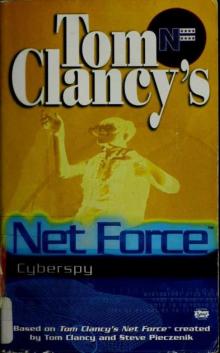 Cyberspy
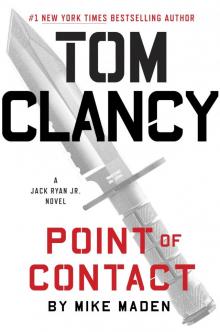 Point of Contact
 Operation Barracuda (2005)
 Choke Point
 Power and Empire
 Every Man a Tiger: The Gulf War Air Campaign
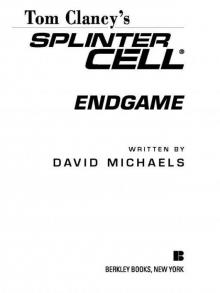 Endgame (1998)
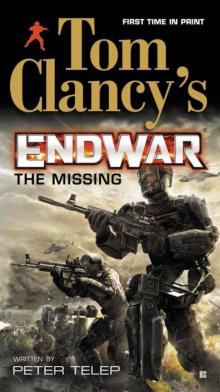 EndWar: The Missing
 Splinter Cell (2004)
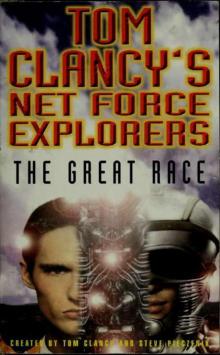 The Great Race
 True Faith and Allegiance
 Deathworld
 Ghost Recon (2008)
 Duel Identity
 Line of Control o-8
 The Hunt for Red October jr-3
 Hidden Agendas nf-2
 Acts of War oc-4
 Ruthless.Com pp-2
 Night Moves
 The Hounds of Rome - Mystery of a Fugitive Priest
 Into the Storm: On the Ground in Iraq sic-1
 Threat Vector jrj-4
 Combat Ops gr-2
 Virtual Vandals nfe-1
 Runaways nfe-16
 Marine: A Guided Tour of a Marine Expeditionary Unit tcml-4
 Shadow Warriors: Inside the Special Forces sic-3
 Jack Ryan Books 1-6
 Cold Case nfe-15
 Changing of the Guard nf-8
 Splinter Cell sc-1
 Battle Ready sic-4
 The Bear and the Dragon jrao-11
 Fighter Wing: A Guided Tour of an Air Force Combat Wing tcml-3
 Patriot Games jr-1
 Jack Ryan Books 7-12
 Mission of Honor o-9
 Private Lives nfe-9
 Operation Barracuda sc-2
 Cold War pp-5
 Point of Impact nf-5
 Red Rabbit jr-9
 The Deadliest Game nfe-2
 Springboard nf-9
 Safe House nfe-10
 EndWar e-1
 Duel Identity nfe-12
 Deathworld nfe-13
 Politika pp-1
 Rainbow Six jr-9
 Tom Clancy's Power Plays 1 - 4
 Endgame sc-6
 Executive Orders jr-7
 Net Force nf-1
 Call to Treason o-11
 Locked On jrj-3
 Against All Enemies
 The Sum of All Fears jr-7
 Sea of Fire o-10
 Fallout sc-4
 Balance of Power o-5
 Shadow Watch pp-3
 State of War nf-7
 Wild Card pp-8
 Games of State o-3
 Death Match nfe-18
 Against All Enemies mm-1
 Every Man a Tiger: The Gulf War Air Campaign sic-2
 Cybernation nf-6
 Support and Defend
 Night Moves nf-3
 SSN
SSN Cutting Edge pp-6
 The Cardinal of the Kremlin jrao-5
 War of Eagles o-12
 Op-Center o-1
 Mirror Image o-2
 The Archimedes Effect nf-10
 Teeth of the Tiger jrj-1
 Bio-Strike pp-4
 State of Siege o-6
 Debt of Honor jr-6
 Zero Hour pp-7
 Ghost Recon gr-1
 Command Authority jr-10
 Tom Clancy's Power Plays 5 - 8
 Checkmate sc-3
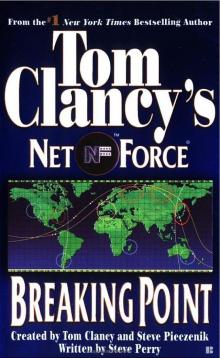 Breaking Point nf-4
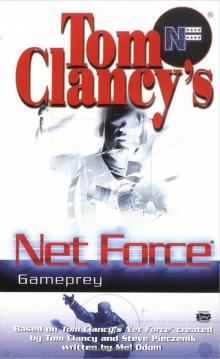 Gameprey nfe-11
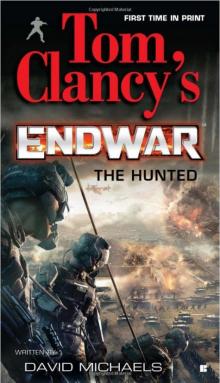 The Hunted e-2
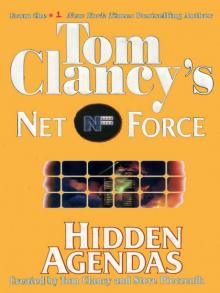 Hidden Agendas
 Divide and Conquer o-7