
- Home
- Tom Clancy
Executive Orders Page 79
Executive Orders Read online
Page 79
A waning moon was overhead, and that gave emphasis to the numberless stars which kept him company. To the west was ancient Ur, once a great city as things had been reckoned, and surely even today it would be a noteworthy sight, with its towering brick walls and its towering ziggurat to whatever false god the people here had worshiped. Caravans would travel in and out of the fortified gates, bringing everything from grain to slaves. The surrounding land would be green with planted fields instead of mere sand, and the air alive with the chatter of merchants and tradesmen. The tale of Eden itself had probably begun not far from here, somewhere in the parallel valleys of the Tigris and Euphrates that emptied into the Persian Gulf. Yes, if humanity were all one vast tree, then the oldest roots were right here, virtually in the center of the country he had just created.
The ancients would have had the same sense of centrality, he was sure. Here are we, they would have thought, and out there were ... they, the universal appellation for those who were not part of one’s own community. They were dangerous. At first they would have been nomadic travelers for whom the idea of a city was incomprehensible. How could one stay in one place and live? Didn’t the grass for the goats and sheep run out? On the other hand, what a fine place to raid, they would have thought. That was why the city had sprouted defensive walls, further emphasizing the primacy of place and the dichotomy of we and they, the civilized and the uncivilized.
And so it was today, Daryaei knew, Faithful and Infidel. Even within the first category there were differences. He stood in the center of a country which was also the center of the Faith, at least in geographic terms, for Islam had spread west and east. The true center of his religion lay in the direction in which he always prayed, southwest, in Mecca, home of the Ka’aba stone, where the Prophet had taught.
Civilization had begun in Ur, and spread, slowly and fitfully, and in the waves of time, the city had risen and fallen because, he thought, of its false gods, its lack of the single unifying idea which civilization needed.
The continuity of this place told him much about the people. One could almost hear their voices, and they were no different, really, from himself. They’d looked up on quiet nights into the same sky and wondered at the beauty of the same stars. They’d heard the silence, the best of them, just as he did, and used it as a sounding board for their most private thoughts, to consider the Great Questions and find their answers as best they could. But they’d been flawed answers, and that was why the walls had fallen, along with all the civilizations here—but one.
And so, his task was to restore, Daryaei told the stars. As his religion was the final revelation, so his culture would grow from here, down-river from the original Eden. Yes, he’d build his city here. Mecca would remain a holy city, blessed and pure, not commercialized, not polluted. There was room here for the administrative buildings. A fresh beginning would take place on the site of the oldest beginning, and a great new nation would grow.
But first ...
Daryaei looked at his hand, old and gnarled, scarred by torture and persecution, but still the hand of a man and the servant of his mind, an imperfect tool, as he himself was an imperfect tool for his God, but a faithful tool even so, able to smite, able to heal. Both would be necessary. He knew the entire Koran by heart—memorization of the entire book was encouraged by his religion—and more than that he was a theologian who could quote a verse to any purpose, some of them contradictory, he admitted to himself, but it was the Will of Allah that mattered more than His words. His words often applied to a specific context. To kill for murder was evil, and the Koranic law on that was harsh indeed. To kill in defense of the Faith was not. Sometimes the difference between the two was clouded, and for that one had the Will of Allah as a guide. Allah wished the Faithful to be under one spiritual roof, and while many had attempted to accomplish that by reason and example, men were weak and some had to be shown more forcefully than others—and perhaps the differences between Sunni and Shi’a could be resolved in peace and love, with his hand extended in friendship and both sides giving respectful consideration to the views of the other—Daryaei was willing to go that far in his quest—but first the proper conditions had to be established. Beyond the horizon of Islam were others, and while God’s Mercy applied to them as well, after a fashion, it did not apply while they sought to injure the Faith. For those people, his hand was for smiting. There was no avoiding it.
Because they did injure the Faith, polluting it with their money and strange ideas, taking the oil away, taking the children away to educate them in corrupt ways. They sought to limit the Faith even as they did business with those who called themselves Faithful. They would resist his efforts to unify Islam. They’d call it economics or politics or something else, but really they knew that a unified Islam would threaten their apostasy and temporal power. They were the worst kind of enemies in that they called themselves friends, and disguised their intentions well enough to be mistaken for such. For Islam to unify, they had to be broken.
There really was no choice for him. He’d come here to be alone and to think, to ask God quietly if there might be another way. But the blue piece of tile had told him of all that had been, the time that had passed, the civilizations that had left nothing behind but imperfect memories and ruined buildings. He had the idea and the faith that they had all lacked. It was merely a question of applying those ideas, guided by the same Will that had placed the stars in the sky. His God had brought flood and plague and misfortune as tools of the Faith. Mohammed had himself fought wars. And so, reluctantly, he told himself, would he.
35
OPERATIONAL CONCEPT
WHEN MILITARY FORCES move, other forces watch with interest, though what they do about it depends on the instructions of their leaders. The move of Iranian forces into Iraq was entirely administrative. The tanks and other tracked vehicles came by low-hauler trailers, while the trucks rolled on their own wheels. There were the usual problems. A few units took wrong turns, to the embarrassment of their officers and the rage of superiors, but soon enough each of the three divisions had found a new home, in every case co-located with a formerly Iraqi division of the same type. The traumatically enforced downsizing of the Iraqi army had made for almost enough room for the new occupants of the bases, and scarcely had they arrived but the staffs were integrated in corps units, and joint exercises began to acquaint one grouping with the other. Here, too, there were the usual difficulties of language and culture, but both sides used much the same weapons and doctrine; and the staff officers, the same all over the world, worked to hammer out a common ground. This, too, was watched from satellite.
“How much?”
“Call it three corps formations,” the briefing officer told Admiral Jackson. “One of two armored divisions, and two of an armored and a heavy mechanized. They’re a little light in artillery, but they have all the rolling stock they need. We spotted a bunch of command-and-control vehicles running around in the desert, probably doing unit-movement simulations for a CPX.” That was a Command-Post Exercise, a war game for professionals.
“Anything else?” Robby asked.
“The gunnery ranges at this base here, west of Abu Sukayr, are being bulldozed and cleaned up, and the air base just north at Nejef has a few new tenants, MiGs and Sukhois, but on IR their engines are cold.”
“Assessment?” This came from Tony Bretano.
“Sir, you can call it anything,” the colonel replied. “New country integrating their military, there’s going to be a lot of getting-to-know-you stuff. We’re surprised by the integrated corps formations. It’s going to pose administrative difficulties, but it might be a good move from the political-psychological side. This way, they’re acting like they really are one country.”
“Nothing threatening at all?” the SecDef asked.
“Nothing overtly threatening, not at this time.”
“How quick could that corps move to the Saudi border?” Jackson asked, to make sure his boss got the real picture.<
br />
“Once they’re fully fueled and trained up? Call it forty-eight to seventy-two hours. We could do it in less than half the time, but we’re trained better.”
“Force composition?”
“Total for the three corps, we’re talking six heavy divisions, just over fifteen hundred main battle tanks, over twenty-five hundred infantry fighting vehicles, upwards of six hundred tubes—still haven’t got a handle on their red team, Admiral. That’s artillery, Mr. Secretary,” the colonel explained. “Logistically they’re on the old Soviet model.”
“What’s that mean?”
“Their loggies are organic to the divisions. We do that also, but we maintain separate formations to keep our maneuver forces running.”
“Reservists for the most part,” Jackson told the Secretary. “The Soviet model allows for a more integrated maneuver force, but only for the short term. They can’t sustain operations as long as we can, in terms of time or distance.”
“The admiral is correct, sir,” the briefing officer went on. “In 1990, when the Iraqis jumped into Kuwait, they went about as far as their logistical tail allowed. They had to stop to replenish.”
“That’s part of it. Tell him the other part,” Jackson ordered.
“After a pause of from twelve to twenty-four hours, they were ready to move again. The reason they didn’t was political.”
“I always wondered about that. Could they have taken the Saudi oil fields?”
“Easy,” the colonel said. “He must have thought a lot about that in later months,” the officer added without sympathy.
“So, we have a threat here?” Bretano was asking simple questions and listening to the answers. Jackson liked that. He knew what he didn’t know, and wasn’t embarrassed about learning things.
“Yes, sir. These three corps represent a potential striking force about equal in power to what Hussein used. There would be other units involved, but they’re just occupying forces. That’s the fist right here,” the colonel said, tapping the map with his pointer.
“But it’s still in their pocket. How long to change that?”
“A few months at minimum to do it right, Mr. Secretary. It depends most of all on their overall political intentions. All of these units are individually trained up to snuff by local standards. Integrating their corps staffs and organizations is the real task ahead for them.”
“Explain,” Bretano ordered.
“Sir, I guess you could call it a management team. Everybody has to get to know everybody else so that they can communicate properly, start thinking the same way.”
“Maybe it’s easier to think of it as a football team, sir.” Robby took it further. “You don’t just take eleven guys and put them in a huddle together and expect them to perform properly. You have to have everybody reading out of the same playbook, and everybody has to know what everybody else is able to do.”
SecDef nodded. “So it’s not the hardware we’re worried about. It’s the people.”
“That’s right, sir,” the colonel said. “I can teach you to drive a tank in a few minutes, but it’ll be a while before I want you driving around in my brigade.”
“That’s why you people must love having a new Secretary come in every few years,” Bretano observed with a wry smile.
“Mostly they learn pretty fast.”
“So, what do we tell the President?”
THE CHINESE AND Taiwanese navies were keeping their respective distances, as though an invisible line were drawn north-south down the Formosa Strait. The latter kept pacing the former, interposing itself between its island home, but informal rules were established and so far none was being violated.
This was good for the CO of USS Pasadena, whose sonar and tracking parties were trying to keep tabs on both sides, all the while hoping that a shooting war wouldn’t start with them in the middle. Getting killed by mistake seemed such a tawdry end.
“Torpedo in the water, bearing two-seven-four!” was the next call from the sonar compartment. Heads turned and ears perked up at once.
“Stay cool,” the captain ordered quietly. “Sonar, Conn, I need more than that!” That statement was not quiet.
“Same bearing as contact Sierra Four-Two, a Luda II-class ’can, sir, probably launched from there.”
“Four-Two is bearing two-seven-four, range thirty thousand yards,” a petty officer in the tracking party interjected at once.
“Sounds like one of their new homers, sir, six blades, turning at high speed, bearing is changing north to south, definite side aspect on the fish.”
“Very well,” the captain said, allowing himself to stay as calm as he pretended to be.
“Could be targeted on Sierra-Fifteen, sir.” That contact was an old Ming-class submarine, a Chinese copy of the old Russian Romeo-class, a clunker whose design dated from the 1950s which had snorted less than an hour before to recharge batteries. “He’s at two-six-one, range about the same.” That came from the officer in charge of the tracking party. The senior chief at his left nodded agreement.
The captain closed his eyes and allowed himself a breath. He’d heard the stories about the Good Old Days of the Cold War, when people like Bart Mancuso had gone Up North into the Barents Sea and, occasionally, found themselves right in the middle of a live-fire ShootEx of the Soviet navy—perhaps mistaken for practice targets, even. A fine opportunity to figure out how good Soviet weapons really were, they joked now, sitting in their offices. Now he knew what they’d really felt at the time. Fortunately, his private head was a mere twenty feet away, if it came to that ...
“Transient, transient, mechanical transient bearing two-six-one, sounds like a noisemaker, probably released by contact Sierra-Fifteen. The torpedo bearing is now two-six-seven, estimated speed four-four knots, bearing continues to change north to south,” sonar reported next. “Hold it—another torpedo in the water bearing two-five-five!”
“No contact on that bearing, could be a helo launch,” the senior chief said.
He’d have to discuss one of those sea stories with Mancuso when he got back to Pearl, the captain thought.
“Same acoustical signature, sir, another homing fish, drifting north, could also be targeted on Sierra-Fifteen.”
“Bracketed the poor bastard.” This came from the XO.
“It’s dark topside, isn’t it?” the captain thought suddenly. Sometimes it was easy to lose track.
“Sure is, sir.” From the XO again.
“Have we seen them do night helo ops this week?”
“No, sir. Intel says they don’t like to fly off their ’cans at night.”
“That just changed, didn’t it? Let’s see. Raise the ESM mast.”
“Raise the ESM, aye.” A sailor pulled the proper handle and the reed-thin electronics-sensor antenna hissed up on hydraulic power. Pasadena was running at periscope depth, her long sonar “tail” streamed out behind her as the submarine stayed roughly on what they hoped was the borderline between the two enemy fleets. It was the safest place to be until such time as real shooting started.
“Looking for—”
“Got it, sir, a Ku-band emitter at bearing two-five-four, aircraft type, frequency and pulse-repetition rate like that new French one. Wow, lots of radars turning, sir, take a while to classify them.”
“French Dauphin helos on some of their frigates, sir,” the XO observed.
“Doing night ops,” the captain emphasized. That was unexpected. Helicopters were expensive, and landing on tin cans at night was always dicey. The Chinese navy was training up to do something.
THINGS COULD BE slippery in Washington. The nation’s capital invariably panics at the report of a single snowflake despite the realization that a blizzard might do little more than fill the potholes in the street, if only people would plow the snow that way. But there was more to it than that. As soldiers once followed flags onto a battlefield, so senior Washington officials follow leaders or ideologies, but near the top it got slippery. A lower- or midd
le-level bureaucrat might just sit at his post and ignore his sitting department Secretary’s identity, but the higher one went, the closer one came to something akin to decision or policy making. In such positions, one actually had to do things, or tell others to do things, from time to time, other than what someone else had already written down. One regularly went in and out of top-floor offices and became identified with whoever might be there, ultimately all the way to the President’s office in the West Wing, and though access to the top meant power of a sort, and prestige, and an autographed photo on the office wall to tell your visitors how important you were, if something happened to the other person in the photo, then the photo and its signature might become a liability rather than an asset. The ultimate risk lay in changing from an insider, always welcome, to an outsider, if not quite always shunned, then forced to earn one’s way back inside, a prospect not attractive to those who had spent so much time getting there in the first place.
The most obvious defense, of course, was to be networked, to have a circle of friends and associates which didn’t have to be deep so much as broad, and include people in all parts of the political spectrum. You had to be known by a sufficiently wide number of fellow insiders so that no matter what happened at the very top there was always a safe platform just below, a safety net of sorts. The net was close enough to the top that the people in it had the upward access without the risk of falling off. With care, those at the top positions enjoyed its protection, too, always able to slide in and out of appropriate postings, to and from other offices not too far away—usually less than a mile—to await the next opportunity, and so even though out, to remain in the Network, to retain the access, and also rent out that access to those who needed it. In that sense, nothing had changed since the pharaonic court in the ancient Nile city of Thebes, where knowing a nobleman who had access to Pharaoh gave one a power which translated into both money and the pure joy of being important enough to bow and scrape for profit.
 Changing of the Guard
 Clear and Present Danger
 Hounds of Rome
 Breaking Point
 Tom Clancy's Jack Ryan Books 7-12
 Full Force and Effect
 The Archimedes Effect
 Combat Ops
 Into the Storm: On the Ground in Iraq
 Under Fire
 Point of Impact
 Red Rabbit
 Rainbow Six
 The Hunt for Red October
 The Teeth of the Tiger
 Conviction (2009)
 Battle Ready
 Patriot Games
 The Sum of All Fears
 Fallout (2007)
 Red Storm Rising
 The Cardinal of the Kremlin
 Executive Orders
 Lincoln, the unknown
 Threat Vector
 The Hunted
 Shadow Warriors: Inside the Special Forces
 End Game
 Special Forces: A Guided Tour of U.S. Army Special Forces
 Locked On
 Line of Sight
 Tom Clancy Enemy Contact - Mike Maden
 Fighter Wing: A Guided Tour of an Air Force Combat Wing
 Springboard
 Line of Sight - Mike Maden
 EndWar
 Dead or Alive
 Tom Clancy Support and Defend
 Checkmate
 Command Authority
 Carrier: A Guided Tour of an Aircraft Carrier
 Blacklist Aftermath
 Marine: A Guided Tour of a Marine Expeditionary Unit
 Commander-In-Chief
 Armored Cav: A Guided Tour of an Armored Cavalry Regiment
 Tom Clancy's Jack Ryan Books 1-6
 The Ultimate Escape
 Airborne: A Guided Tour of an Airborne Task Force
 Debt of Honor
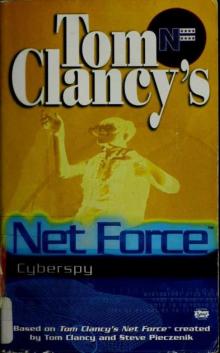 Cyberspy
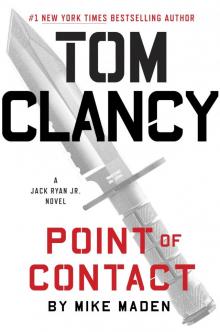 Point of Contact
 Operation Barracuda (2005)
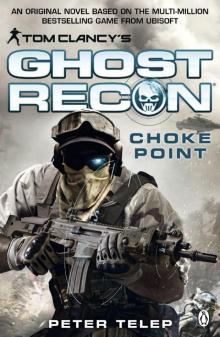 Choke Point
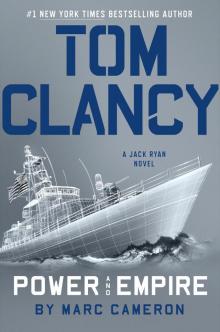 Power and Empire
 Every Man a Tiger: The Gulf War Air Campaign
 Endgame (1998)
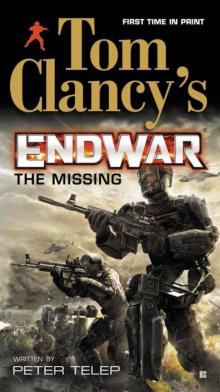 EndWar: The Missing
 Splinter Cell (2004)
 The Great Race
 True Faith and Allegiance
 Deathworld
 Ghost Recon (2008)
 Duel Identity
 Line of Control o-8
 The Hunt for Red October jr-3
 Hidden Agendas nf-2
 Acts of War oc-4
 Ruthless.Com pp-2
 Night Moves
 The Hounds of Rome - Mystery of a Fugitive Priest
 Into the Storm: On the Ground in Iraq sic-1
 Threat Vector jrj-4
 Combat Ops gr-2
 Virtual Vandals nfe-1
 Runaways nfe-16
 Marine: A Guided Tour of a Marine Expeditionary Unit tcml-4
 Shadow Warriors: Inside the Special Forces sic-3
 Jack Ryan Books 1-6
 Cold Case nfe-15
 Changing of the Guard nf-8
 Splinter Cell sc-1
 Battle Ready sic-4
 The Bear and the Dragon jrao-11
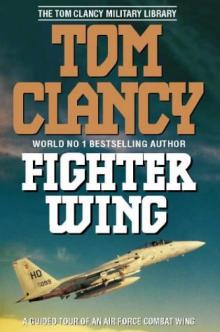 Fighter Wing: A Guided Tour of an Air Force Combat Wing tcml-3
 Patriot Games jr-1
 Jack Ryan Books 7-12
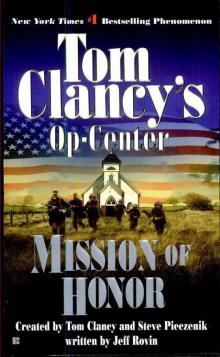 Mission of Honor o-9
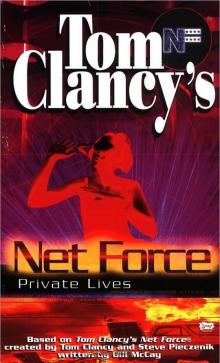 Private Lives nfe-9
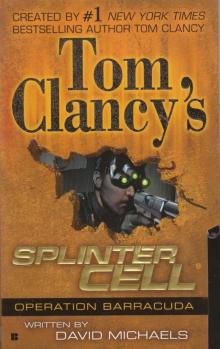 Operation Barracuda sc-2
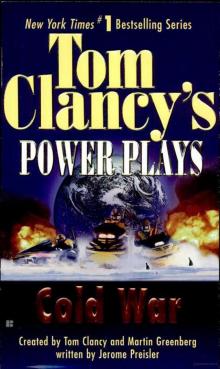 Cold War pp-5
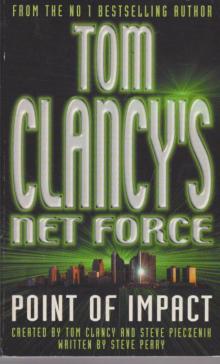 Point of Impact nf-5
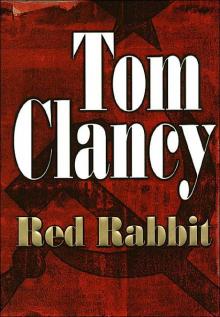 Red Rabbit jr-9
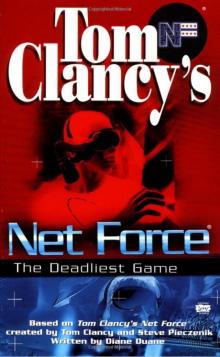 The Deadliest Game nfe-2
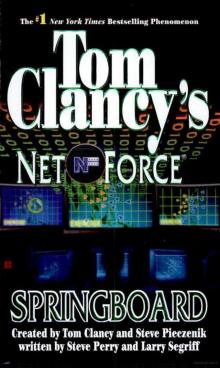 Springboard nf-9
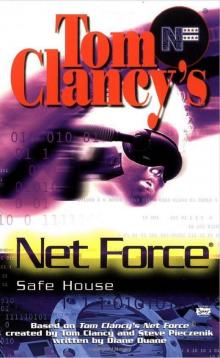 Safe House nfe-10
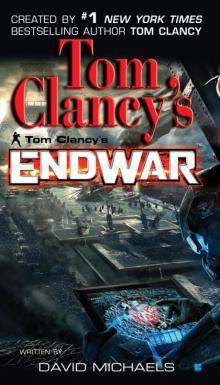 EndWar e-1
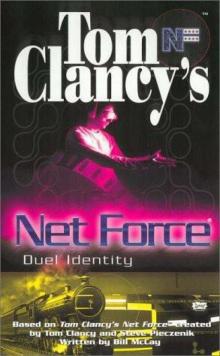 Duel Identity nfe-12
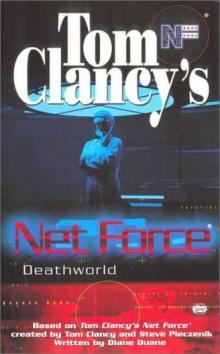 Deathworld nfe-13
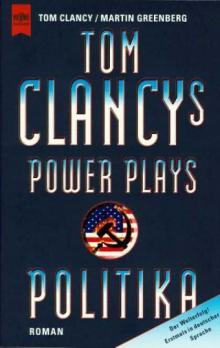 Politika pp-1
 Rainbow Six jr-9
 Tom Clancy's Power Plays 1 - 4
 Endgame sc-6
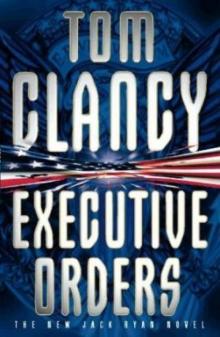 Executive Orders jr-7
 Net Force nf-1
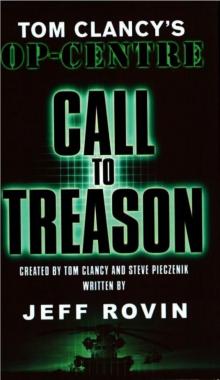 Call to Treason o-11
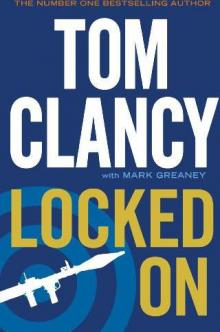 Locked On jrj-3
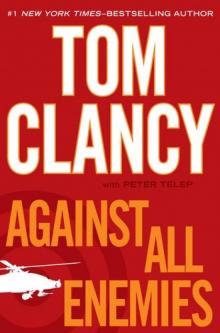 Against All Enemies
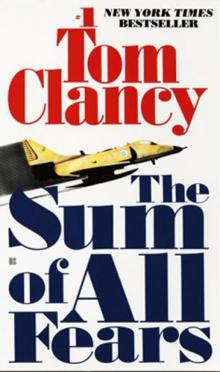 The Sum of All Fears jr-7
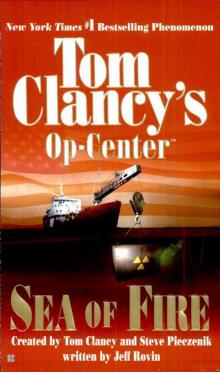 Sea of Fire o-10
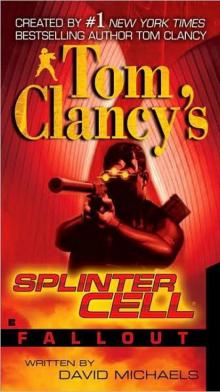 Fallout sc-4
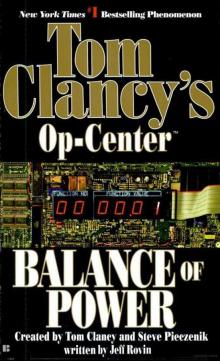 Balance of Power o-5
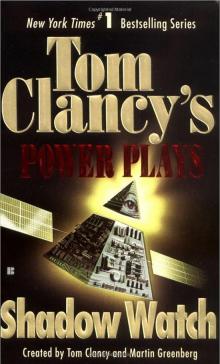 Shadow Watch pp-3
 State of War nf-7
 Wild Card pp-8
 Games of State o-3
 Death Match nfe-18
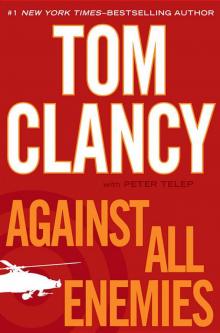 Against All Enemies mm-1
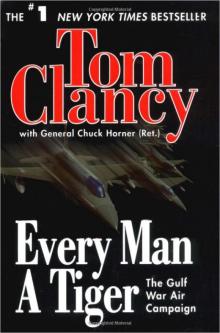 Every Man a Tiger: The Gulf War Air Campaign sic-2
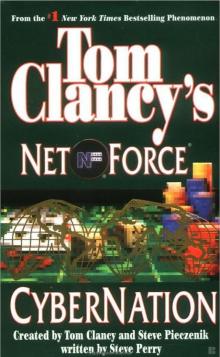 Cybernation nf-6
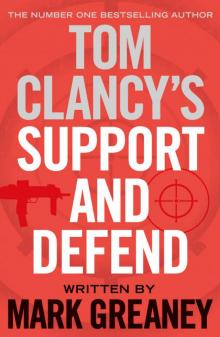 Support and Defend
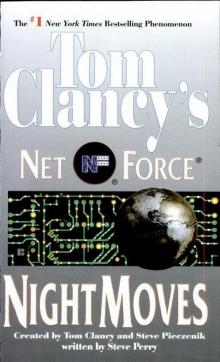 Night Moves nf-3
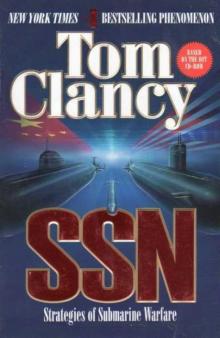 SSN
SSN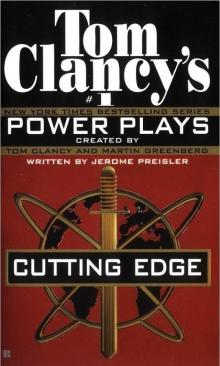 Cutting Edge pp-6
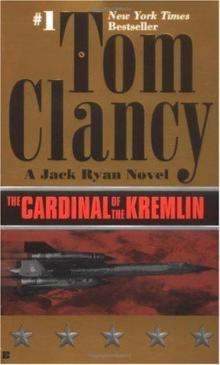 The Cardinal of the Kremlin jrao-5
 War of Eagles o-12
 Op-Center o-1
 Mirror Image o-2
 The Archimedes Effect nf-10
 Teeth of the Tiger jrj-1
 Bio-Strike pp-4
 State of Siege o-6
 Debt of Honor jr-6
 Zero Hour pp-7
 Ghost Recon gr-1
 Command Authority jr-10
 Tom Clancy's Power Plays 5 - 8
 Checkmate sc-3
 Breaking Point nf-4
 Gameprey nfe-11
 The Hunted e-2
 Hidden Agendas
 Divide and Conquer o-7