
- Home
- Tom Clancy
Threat Vector Page 57
Threat Vector Read online
Page 57
They had Ryan climb on the back of one of the bikes, which was not a great plan, considering Jack was six-two and he found himself riding tandem with a chubby young man who might have been five-four. He had to concentrate on his balance to keep upright as the little Chinese man fishtailed and lurched his straining, poorly tuned bike on the bad back roads.
After twenty minutes on the road Jack saw why the Chinese men were concerned about his leather shoes. They were surrounded by rice paddies that went all the way to a river, across which was the mainland. They would have to slosh in knee-deep water for a half-mile before even getting to the levee by the river. There was no way in hell his loafers would stay on his feet.
They parked their bikes and got out, and then one of the young men miraculously discovered an ability to speak English. “You pay. You pay now.”
Ryan had no problem reaching into his money belt and thumbing off a few hundred bucks for the service these men provided, but Yao had been adamant that he not pay them. Jack shook his head. “Adam Yao to pay,” he said, hoping his nonconjugated verb might make comprehension easier.
Oddly, the men seemed not to understand this. “Adam pay you,” Jack tried next.
The men just shook their heads like they did not understand, and said, “You pay now.”
Jack reached into his pocket and pulled out a mobile phone he’d purchased that afternoon at the airport, and he dialed a number.
“Yeah?”
“It’s Jack. They want money.”
Yao growled like an angry bear, which surprised Ryan. “Put the smartest-looking of those three dumb shits on the fucking phone.”
Jack smiled. He liked Adam Yao’s style. “It’s for you.” He handed the phone to one of the smugglers.
There was a quick conversation. Jack did not understand the words, but the facial expressions from the kid left no uncertainty as to who had the upper hand in the argument. The kid winced with Yao’s words and fought to get his responses in.
After thirty seconds he passed the phone back to Ryan.
Jack held the phone up to his ear. Before he could speak, Yao said, “That ought to be the end of that. We’re back on, but don’t show those bastards a dime.”
“Okay.”
They sloshed through the rice paddies as the sun set and the moon rose. Jack lost his shoes almost immediately. There was a little conversation at first, but as they neared the water all the talking stopped. At eight p.m. they arrived on the levee, and one of the men pulled a raft made of milk cartons and particle board out of tall grasses. Ryan and the smuggler climbed aboard, and the other two pushed them off.
It was only five minutes across the cold water to China. They landed in a warehouse district of Shenzhen, and they hid the raft in rocks and river grasses. The smuggler went with Ryan up to the street in the dark, they sprinted across just after a bus passed, and then Jack was told to wait in a tin storage shed.
The smuggler disappeared, and Jack dialed Yao again.
Adam answered, quickly. “I’ll be there in under a minute.”
Yao picked Jack up and immediately headed north. He said, “We go through Shenzhen and then hit Guangzhou in about an hour. Center’s building is in the northern part of the city, out in the suburbs near the airport.”
“How did you find it?”
“I tracked him from the movements of their supercomputers in Hong Kong. The servers traveled by ship, and I found the ship, the port, then the trucking company that brought them to the China Telecom building. I wasn’t sure at first, but then I chatted up a girl at the new China Telecom office who said she came into work one morning and found out her entire building had been vacated overnight because the PLA needed the space.
“At that point I was pretty sure, so I got an apartment in a high-rise across a drainage culvert from the CT building. I can see the Army guarding the place, and I can see the civilians coming and going. They installed a satellite barn in the parking lot and have huge dishes on the roof. They must be using a ton of electricity.”
“What’s the next step?”
Yao shrugged. “The next step is you tell me who you really work for. I didn’t ask you over here because I needed a friend. I need someone on the inside in the U.S., away from CIA. Someone who can make something happen.”
“Make what happen, exactly?”
Yao shook his head. “I want you to be able to contact someone in the government, high up in the government not at CIA, and tell them what’s going on. We will be able to prove it beyond a shadow of a doubt. And then when you do that, I want someone to come over here and blow it up.”
“You want me to call my dad.”
Yao shrugged. “He could make it happen.”
Ryan shook his head. He had to keep his dad insulated, to some degree, from his operations. He said, “There is someone else I can call. She’ll get the message through.”
SEVENTY-THREE
President Jack Ryan decided he would travel to the Pentagon to hear their plan to attack China’s computer networking infrastructure and computer network operations capability. Most of America’s top war-fighting strategists had been working on nothing else there in the building, doing their best to ad-lib parts of the tactical plan because the cyberattack on America had hamstrung their capabilities to get information, advice, and a good picture of the battle space.
Napoleon is credited with saying an army marches on its stomach. But that was in Napoleon’s time. Now it was clear to everyone affected by the attacks that the U.S. military marched on its bandwidth, and at the moment it seemed it could do little more than stand at parade rest.
And in the two days since his directive to draw up the plan, the situation had gotten worse. In addition to increased cyberattacks on the United States—attacks that had shut down two days of trading on Wall Street—the Chinese had exploited other attack vectors against the military. Many American military and spy satellites had been hacked and their signals corrupted, so critical data were not getting from the theater to the Pentagon. Those satellites still online were sending back data sluggishly or sporadically corrupted, meaning the picture of the situation over there was spotty at best.
The United States had lost visibility of the Chinese carrier in the South China Sea, and only received clues of its location again when an Indonesian Navy frigate, Yos Sudarso, was sunk eighty miles north of Bunguran Timur, reportedly by four missiles fired from a Chinese attack helicopter. Of the one hundred seventy sailors on board, only thirty-nine had been recovered alive as of twelve hours after the incident.
More air-to-air contests over the Taiwan Strait had resulted in the shooting down of five more ROC fighters and a Marine Hornet, compared with the loss of eight PLAAF aircraft.
Ryan sat quietly as colonels, generals, captains, and admirals briefed him on the options for a military strike or, more precisely, on the seeming lack of options for a military strike.
The most frightening aspect of building a target list, clearly, was the poor coverage of the area. The degradation of the satellite data, more than anything else, made much of their attack plan a crapshoot, and the men and women in the room admitted as much to the President.
Ryan asked, “But some of our satellites are still functional?”
Burgess fielded this one: “Yes, Mr. President. But what you have to realize is, other than the dogfights over the Strait of Taiwan, the shooting war between the U.S. and China has not begun. Everything they’ve done to us to muddle our ability to fight, they’ve done with computer code. If we do attack, or if we do move carriers closer to attack or in any way show our hand, you can bet they will use shooting-war measures to disrupt those satellite feeds.”
Ryan said, “Shooting down our satellites?”
Burgess nodded. “They have shown their ability, in a test against their own equipment, to destroy a
satellite with a kinetic missile.”
Ryan remembered the event.
“Do they have the capability to do that on a large scale?”
An Air Force general spoke up: “Kinetic ASAT, or antisatellite weapons, are no one’s first choice. They are bad for all parties with space platforms, because the debris from a strike can orbit for decades and fly into other equipment in space. It only takes a particle about one centimeter in length to mission-kill a satellite. The Chinese know that, so we don’t think they will blow up our equipment in space unless they absolutely have to.”
Ryan said, “They also can attack our satellites over China with an electromagnetic pulse weapon, an EMP.”
Burgess shook his head. “The Chinese will not detonate an EMP in space.”
Ryan cocked his head. “How can you be so sure, Bob?”
“Because it would damage their own equipment. They have GPS and communications satellites up above their own nation, of course, not far enough away from our platforms.”
Jack nodded. That was the kind of analysis he appreciated. The kind that made sense. “Do they have other tricks up their sleeves?”
The Air Force general said, “Yes, absolutely they do. The PLA also has the ability to temporarily blind satellites with the use of high-powered lasers. The technique is called ‘dazzling’; they have done it on the French and Indian satellites in the past two years with great success. In both cases they totally degraded the satellite’s ability to see and communicate with the ground for three or four hours. We predict they will start with this, and if it does not give them the results they want, then they will start firing missiles into space to shoot down our communications and intelligence-collection platforms.”
Ryan shook his head in frustration. “A couple months back I made a speech to the UN and said that any attack on a U.S. satellite was an attack on U.S. territory. The next morning half the news organizations in the country and three-fifths on the planet were running headlines saying I was claiming outer space for the United States. The L.A. Times had a caricature of me dressed like Darth Vader on their opinion page. America’s chattering class does not get the stakes we’re up against.”
Burgess said, “You did the right thing. The future of warfare is going to be brand-new territory, Mr. President. Looks like we’re the lucky ones who get to blaze a trail.”
“Okay,” Ryan said, “we’re half blind in the sky; what does the picture look like at sea level?”
A Navy admiral stood and said, “Anti-access/area-denial. A-two A-D, sir. China does not possess a great Navy, but they have the largest and most active land-based ballistic and cruise missile programs in the world. The PLA’s Second Artillery Corps has five operational short-range ballistic missile brigades targeting Taiwan. DIA estimates they have over one thousand missiles.”
A captain stood in front of a whiteboard festooned with notes for the President to read in lieu of a PowerPoint presentation. “Second Artillery Corps conventional anti-ship ballistic missiles also provide the PLA with an extra deployment option to enhance its anti-access/area-denial strategies against offshore threats.
“Their ocean surveillance system over-the-horizon radar will see a carrier battle group at a distance of one thousand eight hundred miles, and then their electronic signal–detection satellites will pinpoint and identify the ships.
“The battle group emissions are detected and the track is predicted, even through cloud cover.
“The Dong Feng 21D is their carrier-killer ballistic missile. It has its own radar, and it also pulls tracking information from Chinese satellite data.”
It continued like this for an hour. Ryan was careful to keep the momentum of the discussion up; he saw it as a waste of time for these men and women to be forced to explain the nuances of every weapons system of both sides to a man who had only to give a thumbs-up or a thumbs-down to the entire operation.
But he had to strike a balance. In his role as the man with the thumb, he owed it to America’s war fighters to be as educated as possible on their options before ordering hundreds—no, thousands—of people into harm’s way.
After an entire morning of back-and-forth, a Navy admiral, a former F-14 Tomcat pilot who’d led carrier wings and was now one of the Pentagon’s top naval tacticians, took the President through the plan of attack on China. It involved nuclear subs in the East China Sea launching barrages of conventional missiles at PLA command-and-control centers and technical bureaus, as well as targeting electrical infrastructure that powered these locations.
Simultaneously, subs in the Taiwan Strait and off the coast of the Chinese city of Fuzhou would launch cruise missiles against PLAAF air bases, known fixed-missile batteries, and command-and-control facilities.
American strike aircraft would fly from the Reagan and the Nimitz, refuel while still far out to sea, and then strike up and down the Chinese coast near the Taiwan Strait, taking out SAM sites, warships in port and at sea, and a huge target list of anti-access/area-denial capabilities, including anti-ship ballistic missile sites that the Chinese maintained in the south of the country.
The admiral admitted that hundreds, if not thousands, of the PLA’s best missiles were fired from mobile launchers, and the poor overhead picture of the area meant those missiles would survive any attack the Americans could mount.
Ryan was floored by the scope and obvious difficulties the Navy would face in this seemingly impossible task. He knew he had to ask the next question, but he feared the answer.
“What are your predictions as to losses to U.S. forces?”
The admiral looked at the top page of his notepad. “To flight crews? Fifty percent. If we had better visualization, then that would be significantly less, but we have to deal with the battle space as it now exists, not as we had war-gamed it in the past.”
Ryan blew out a sigh. “So we lose a hundred pilots.”
“Say sixty-five to eighty-five. That will go up if follow-on strikes are necessary.”
“Go on.”
“We will lose submarines as well. It’s anyone’s guess how many, but every one of those subs has to go shallow and reveal itself in waters where the PLAN is active and the PLAAF is overhead, so they will all be at risk.”
Jack Ryan thought about losing a submarine. All those young Americans, acting on his orders, and then dying a death that Jack had always considered to be about the most horrific imaginable.
He looked up at the admiral after a moment of contemplation. “The Reagan and the Nimitz. They will be in imminent danger of a response from China.”
“Absolutely, sir. We expect the Dong Feng will be employed in combat for the first time. We don’t know how good it is, frankly, but to say we are hoping it does not work as advertised would be about the biggest understatement anyone could make. Obviously we have a number of countermeasures that our ships will employ. But many of those countermeasures rely on networking and good satellite data, neither of which we have much of right now.”
All totaled, Ryan was told he could expect to lose between one thousand and ten thousand lives in the attack on China. The number could, and likely would, explode if Taiwan was attacked in retaliation.
The President asked, “Do we think this will short-circuit the cyberattacks against America?”
Bob Burgess spoke up now: “The best minds at Fort Meade’s NSA and Cyber Command cannot answer that, Mr. President. Much of our understanding of China’s computer network attack infrastructure and bureaucratic architecture is, frankly, theoretical. We only hope to temporarily deteriorate their cyberattack capabilities and disrupt their conventional attack capabilities near Taiwan. Deteriorate and disrupt, temporarily, at the cost of upward of ten thousand lives.”
The Navy admiral spoke now, though this was not exactly his area of expertise: “Mr. President, with respect, the cyberattacks on America will
kill more than ten thousand people this winter.”
“That’s a very good point, Admiral,” Ryan admitted.
Ryan’s chief of staff, Arnie van Damm, stepped into the conference room and spoke in the President’s ear.
“Jack, Mary Pat Foley is here.”
“At the Pentagon? Why?”
“She needs to see you. She apologizes, but says it’s urgent.”
Jack knew she would not be here if she didn’t have a good reason. He addressed the room: “Ladies and gentlemen, let’s break for fifteen minutes and pick back up where we left off.”
—
Ryan and Foley were shown to the anteroom of the secretary of the Navy’s office and then left alone. They both remained standing.
“I’m sorry for barging in like this, but—”
“Not at all. What’s so important?”
“CIA has had a nonofficial cover operative who had been working in Hong Kong, on his own initiative and without CIA support. He is the one who located the Chinese hacker involved in the UAV attacks.”
Ryan nodded. “The kid who was killed in Georgetown with the Agency guys.”
“Exactly. Well, we thought we lost him, he disappeared a few weeks ago, but he just emerged and got a message to us from inside China.” She paused. “He has located the nerve center of much of the cyberattack on the United States.”
“What does that mean? I just spent all morning listening to a room full of generals tell me China’s cybernetwork operations were in bureaus and CIC centers all over the country.”
Mary Pat said, “While that might be true, the architect of the overall strategy and the man in charge of the operation against us right now is located in a building in the suburbs of Guangzhou. He, a staff of a couple hundred hackers and engineers, and several mainframe computers are all in one place. One place that we have pinpointed. We are nearly certain that the vast majority of China’s cyberwar is being fought out of that building.”
 Changing of the Guard
 Clear and Present Danger
 Hounds of Rome
 Breaking Point
 Tom Clancy's Jack Ryan Books 7-12
 Full Force and Effect
 The Archimedes Effect
 Combat Ops
 Into the Storm: On the Ground in Iraq
 Under Fire
 Point of Impact
 Red Rabbit
 Rainbow Six
 The Hunt for Red October
 The Teeth of the Tiger
 Conviction (2009)
 Battle Ready
 Patriot Games
 The Sum of All Fears
 Fallout (2007)
 Red Storm Rising
 The Cardinal of the Kremlin
 Executive Orders
 Lincoln, the unknown
 Threat Vector
 The Hunted
 Shadow Warriors: Inside the Special Forces
 End Game
 Special Forces: A Guided Tour of U.S. Army Special Forces
 Locked On
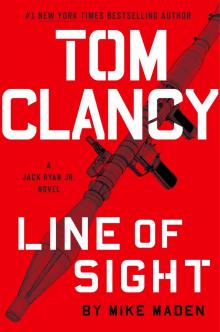 Line of Sight
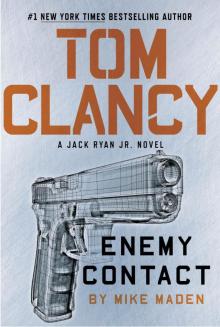 Tom Clancy Enemy Contact - Mike Maden
 Fighter Wing: A Guided Tour of an Air Force Combat Wing
 Springboard
 Line of Sight - Mike Maden
 EndWar
 Dead or Alive
 Tom Clancy Support and Defend
 Checkmate
 Command Authority
 Carrier: A Guided Tour of an Aircraft Carrier
 Blacklist Aftermath
 Marine: A Guided Tour of a Marine Expeditionary Unit
 Commander-In-Chief
 Armored Cav: A Guided Tour of an Armored Cavalry Regiment
 Tom Clancy's Jack Ryan Books 1-6
 The Ultimate Escape
 Airborne: A Guided Tour of an Airborne Task Force
 Debt of Honor
 Cyberspy
 Point of Contact
 Operation Barracuda (2005)
 Choke Point
 Power and Empire
 Every Man a Tiger: The Gulf War Air Campaign
 Endgame (1998)
 EndWar: The Missing
 Splinter Cell (2004)
 The Great Race
 True Faith and Allegiance
 Deathworld
 Ghost Recon (2008)
 Duel Identity
 Line of Control o-8
 The Hunt for Red October jr-3
 Hidden Agendas nf-2
 Acts of War oc-4
 Ruthless.Com pp-2
 Night Moves
 The Hounds of Rome - Mystery of a Fugitive Priest
 Into the Storm: On the Ground in Iraq sic-1
 Threat Vector jrj-4
 Combat Ops gr-2
 Virtual Vandals nfe-1
 Runaways nfe-16
 Marine: A Guided Tour of a Marine Expeditionary Unit tcml-4
 Shadow Warriors: Inside the Special Forces sic-3
 Jack Ryan Books 1-6
 Cold Case nfe-15
 Changing of the Guard nf-8
 Splinter Cell sc-1
 Battle Ready sic-4
 The Bear and the Dragon jrao-11
 Fighter Wing: A Guided Tour of an Air Force Combat Wing tcml-3
 Patriot Games jr-1
 Jack Ryan Books 7-12
 Mission of Honor o-9
 Private Lives nfe-9
 Operation Barracuda sc-2
 Cold War pp-5
 Point of Impact nf-5
 Red Rabbit jr-9
 The Deadliest Game nfe-2
 Springboard nf-9
 Safe House nfe-10
 EndWar e-1
 Duel Identity nfe-12
 Deathworld nfe-13
 Politika pp-1
 Rainbow Six jr-9
 Tom Clancy's Power Plays 1 - 4
 Endgame sc-6
 Executive Orders jr-7
 Net Force nf-1
 Call to Treason o-11
 Locked On jrj-3
 Against All Enemies
 The Sum of All Fears jr-7
 Sea of Fire o-10
 Fallout sc-4
 Balance of Power o-5
 Shadow Watch pp-3
 State of War nf-7
 Wild Card pp-8
 Games of State o-3
 Death Match nfe-18
 Against All Enemies mm-1
 Every Man a Tiger: The Gulf War Air Campaign sic-2
 Cybernation nf-6
 Support and Defend
 Night Moves nf-3
 SSN
SSN Cutting Edge pp-6
 The Cardinal of the Kremlin jrao-5
 War of Eagles o-12
 Op-Center o-1
 Mirror Image o-2
 The Archimedes Effect nf-10
 Teeth of the Tiger jrj-1
 Bio-Strike pp-4
 State of Siege o-6
 Debt of Honor jr-6
 Zero Hour pp-7
 Ghost Recon gr-1
 Command Authority jr-10
 Tom Clancy's Power Plays 5 - 8
 Checkmate sc-3
 Breaking Point nf-4
 Gameprey nfe-11
 The Hunted e-2
 Hidden Agendas
 Divide and Conquer o-7