
- Home
- Tom Clancy
Battle Ready Page 50
Battle Ready Read online
Page 50
The greatest enjoyment for a teacher is to see that moment of discovery or that moment of doubt that wasn’t there before, but now presents the student with a spur to reason.
Learning is guided discovery. The guide is the teacher. His scholarship provides the factual basis for the student’s journey of discovery; and his leadership, personal example, and mentoring skills provide the moral basis. A teacher’s competence, therefore, comes in two inseparable parts. He must be expert in his subject and he must be qualified in his leadership ability. Technical competence alone is not sufficient. Leading and teaching are synonymous. You cannot assume to do one without the other.
As a teacher, I strive to meet the obligations articulated in this philosophy. It requires me to develop in myself the mental, physical, and spiritual qualities I desire to impart and instill in my students.
As a young captain, I began writing down everything I believed about my profession. I expressed my beliefs, asked others to challenge them, and sought more insight into each of them. I continuously changed or altered them as a result.
Over time these dynamic beliefs settled into three categories: those that I was absolutely sure were right; those that I was pretty sure were right; and those that were up for grabs. It was an even split, with new ideas coming and some old ones going; they were in a constant state of morphing over time. I called these my “Combat Concepts.” To me they were a mechanism for continuous learning.
The particular concepts themselves don’t matter as much as the process. This process was so important to me that I extended it from war fighting to other areas—leadership, life, other people, team building. I kept asking myself: “What makes people tick? What do they want in life? What makes teams tick? How can I bring them together more strongly and effectively?”
I’d write down my thoughts on these things, but they were always open to challenge and to change. I wanted always to be able to keep examining my core. I learned long ago that when you stop examining your core, you can really be shaken when you take a hard hit.
AMERICA AND THE WORLD
Our country is great. It has become great because it strives to be good. That is, our country is values based . . . values we hold dear in good times and bad. Our country is admired, respected, envied, and hated for its greatness. To some it is the beacon that Jefferson said we should strive to be. It offers hope and promise. As a first-generation American, I know what that means. Everything is possible here.
We have to stay with all that. We might not always succeed, but we must always try. It’s important not to stop being America when we take bad hits. It’s most important for America to be America when it’s hardest to be America. When the going gets tough, the temptation is to start compromising on our values. After 9/11, it’s been hard to be America. True leadership is not to slip into compromises.
WE ARE now an empire. Not an empire of conquest in the traditional sense. We are an empire of influence. Our power, our values, our promise affect the world. We are more than Jefferson’s beacon. We are an expectation of better things. The world demands of us the delivery of the promise we project. We are seen to have an obligation to share our light. Other peoples want help, leadership, and guidance in getting to where we are. They want our help in reaching their potential. But they don’t want or expect us to put them on the dole. Go back to what I said about teaching. They want us to show them how to move up to what we are. They don’t want handouts.
We are, however, reluctant to deliver. We have never comfortably settled on our role in the world or on our obligations to the other citizens of this planet. The Wilsonian dream of using our blessings to better the world has always clashed with the opposing isolationist heritage to “avoid foreign entanglements.” In my view, this will be the true issue with which we will have to come to grips in this century. The world at our gates demands it of us.
And it’s not a clean, well-ordered world. It’s messy. A lot of folks don’t like us. Or they envy us. Or they don’t like the way we throw our weight around.
In a sense, it’s going to be back to the future: Today’s international landscape has strong similarities to the Caribbean region of the 1920s and ’30s—unstable countries being driven by uncaring dictators to the point of collapse and total failure. We are going to see more crippled states and failed states that look like Somalia and Afghanistan—and are just as dangerous. And more and more U.S. military men and women are going to be involved in vague, confusing military actions—heavily overlaid with political, humanitarian, and economic considerations. And those representing the United States—the Big Guy with the most formidable presence—will have to deal with each messy situation and pull everything together. We’re going to see more and more of that.
Certain of these collapsed states will continue to provide sanctuary to extremist groups who will continue to use these bases to plan, train, and organize for strikes against U.S. forces and other targets. Natural and man-made humanitarian catastrophes will continue to be on the rise; along with civil strife that seems out of control in many parts of the world. Regional hegemons and rogue states will learn the lessons of our wars with Iraq and develop what we call “asymmetric” capabilities—threats designed to exploit our evident military vulnerabilities and gaps. These threats range the spectrum from weapons of mass destruction and long-range missiles to low-tech sea mines and terrorist tactics. All are designed to challenge a perceived weakness in our military, political, or psychological ability to use force.
Victory no longer happens when you capture the enemy capital. And we can’t just declare victory in a photo op on an aircraft carrier. These events signal that the home team is ahead in the third inning. The game goes nine innings—or longer if necessary; and victory happens when you put in place a lasting, stable environment.
Globalization and the explosion of information technology have meanwhile made the world ever more interdependent and interconnected. Geographic obstacles such as oceans and mountain ranges no longer provide impenetrable boundaries. Economic, political, or social-related instability in remote parts of the world will likewise continue to affect our security interests and well-being on our ever-shrinking planet. Added to that will be the continued rise of non-state entities, such as nongovernmental organizations, transnational criminal groups, extremist organizations, global corporations, and warlord groups, all bringing a confusing new dimension to a world previously dominated by the interactions of nation-states.
In recent years, an arc covering a large part of the earth’s surface—from North Africa to the Philippines, and from Central Asia to Central Africa—is chaotic and in turmoil. We are going to be dealing with this turmoil for decades. Remote places such as Somalia, Haiti, Bosnia, Serbia, Kosovo, Rwanda, East Timor, Aceh, Colombia, and others have become flash points that required our intervention at some level. At the same time, the need to contain regional threats such as Iran, Iraq, and North Korea still remained a major military requirement. These became more threatening as they developed greater military capabilities aimed at denying us access to their regions and to our allies within those regions. More and more, our security interests have drawn us into remote, unstable parts of the world.
As a result of these commitments, our shrinking and adjusting armed forces were hit by an onslaught of strange, nontraditional missions that pressured their dwindling ranks and resources with an operational and personnel tempo that was not sustainable. With some exceptions, the U.S. military resisted these missions and the adjustments it should have made in doctrine, organization, training, and equipment needed to meet this growing new mix of commitments. Traditionalists in the military leadership insisted on holding the line; they wanted to fight only our nation’s wars, and hoped to go back to “real soldiering” as they were mending a transitioning force suffering from all the pressures on it. One of our most senior military leaders was quoted as saying, “Real men don’t do OOTW”—a term that became the title for all of those messy little low-end co
mmitments (we now call these missions “Stability Operations”).
THE TWENTY-FIRST-CENTURY MILITARY
Several serious questions and challenges face our military. The first has to do with the growing number of these nontraditional threats. Will these continue to increase, with new types added to the confusing mix, and will we rely on the military as our principal instrument to deal with them? Second, can we afford the kind of military that can meet all the potential challenges ahead? The third question relates to the much-needed military reform. Can the military change, reform, or transform to meet the challenges of the new century and adapt to the rapid development of new technologies that could radically alter the military as we know it today? The fourth issue deals with the interagency reform necessary for other agencies to move in parallel with military reforms. Can we meet the demand for better decision making and the integration of all the instruments of power (political, economic, informational, etc.) to solve the multidimensional challenges ahead?
No one can predict the future, but we can make judgments on the growing number of threats that now face us. Some of these will not be what we have grown used to preparing for.
Our security interests will require that we have a military capable and prepared to respond to:
• A global power with significant military capabilities.
• Regional hegemons with asymmetric capabilities, such as weapons of mass destruction and missiles, designed to deny us access to vital areas and regional allies.
• Transnational threats that include terrorist groups, international criminal and drug organizations, warlords, environmental security issues, issues of health and disease, and illegal migrations.
• Problems of failed or incapable states that require peacekeeping, humanitarian assistance and disaster relief, or national reconstruction.
• Overseas crises that threaten U.S. citizens and property.
• Domestic emergencies that exceed the capacity of other federal and local government agencies to handle.
• Threats to our key repositories of information and to our systems of moving information.
This demanding list of requirements does not include many of the clean, clear war-fighting missions our military would prefer. We have sworn to defend against “all enemies foreign and domestic.” But today the “enemies” that threaten our well-being may include some strange, nontraditional ones.
At this moment in Iraq, we are dealing with the Jihadis, who are coming in from outside to raise hell; crime on the streets is rampant; ex-Ba’athists and Fedayeen are still running around making trouble; American soldiers are getting blown up; suicide bombings have driven out the UN and many NGOs; and there is a potential now for the country to fragment—Shia on Shia, Shia on Sunni, Kurds on Turkomans; you name it. It is a powder keg. If there is a center that can hold this mess together, I don’t know what it is. Civil war could break out at any time. Resources are needed; a strategy is needed; and a plan is needed.
This is not the kind of conflict for which we have traditionally planned. War fighting is only one element of it. Some people on the battlefield don’t play according to our rules. They do not come in military formations and with standard-issue equipment. They come in many different forms; and all of their agendas are different.
The destabilizing environment in which we may commit forces to confront many of these threats may be further degraded by the effects of urbanization, economic depression, overpopulation, and the depletion of basic resources. The world has become reliant on natural resources and raw materials that come from increasingly unstable regions, with the compounding problems of a poor infrastructure and environment. Access to energy resources, water sources, timber, rare gems and metals, etc., is becoming a growing rationale for intervention and conflict in many parts of the world.
We will also require that our forces continue to meet the peacetime demands of engagement and shaping. The importance of maintaining stable regions by building viable, interoperable coalitions with the forces of regional allies will remain necessary to ensure our security in key areas of the world. Military engagement produces dividends in deterrence, confidence building, and burden sharing, and also demonstrates our commitment and resolve. Yet these tasks will continue to tax our already thinly stretched forces.
Some proposals have been put forward to achieve—and afford—a military transformation by drastically cutting our force structure, removing forward-based and -deployed forces from overseas, and stopping modernization. Advocates of such a “strategic pause” think we can withdraw from the world and opt out of interventions that threaten our interests. They are wrong. They are blind to the world as it is. We cannot gamble on a self-ordering world. The risk to us could be great—even fatal—if we are not capable of dealing with an unforeseen threat that emerges from this disordered global environment.
The need right now is critical to transform our military in a deliberate and thoughtful, yet significant, way. Americans must acknowledge this need and support investment in this transformation for it to succeed. This will require a stronger and closer relationship between Americans and their military. This relationship has drifted apart, and has even been strained at times, since the end of the Vietnam War and the institution of the all-volunteer force.
What should be the shape of that transformation?
The military traditionally goes out there and kills people and breaks things. From that, we determine how we are going to straighten out the mess or resolve the conflict. Once upon a time, we looked at the other elements of national power—political, economic, information, whatever—to figure out how we could bring them to bear. That’s what George Marshall did at the end of World War Two. It has not happened in recent times.
The military does a damned good job of killing people and breaking things. We can design a better rifle squad than anybody in the world. We can build a better fighter, a better ship, a better tank, a smarter bomb. We are so far ahead of any potential enemy right now in those kinds of technological areas, in the areas of expertise, of quality of leadership, and of all the other elements that make military units great on the battlefield, that you wonder why we keep busting brain cells working to make it better, or to transform it into something else.
Transformation has to include finding better and more remarkable ways to tap into technology, our own brainpower, our training and education, and creative ways of redesigning our organization to make our military even more efficient and more powerful on the battlefield.
But transformation has to go beyond that.
What is the role of the military beyond killing people and breaking things?
Right now, the military in Iraq has been stuck with that baby. In Somalia, we were stuck with that baby. In Vietnam, we were stuck with that baby. It is not a new role, and it is going to continue. We have to ask ourselves how the military needs to change in order to actually deal with these political, economic, social, security, and information management challenges that we’ve already been facing for a long time. If those wearing suits can’t come in and solve the problem—can’t bring the resources, the expertise, the organization to bear—and the military is going to continue to get stuck with it, you have two choices: Either the civilian officials must develop the capabilities demanded of them and learn how to partner with other agencies to get the job done, or the military finally needs to change into something else beyond the breaking and the killing.
What could this mean?
It could mean that we return to a military that’s a calling and not just a job. For more than a quarter-century, we have been operating with an All-Volunteer Force—and the American people tend to forget that, until the volunteers stop showing up and reenlisting. The troops will start getting out because they’re deployed too long and too often. We need sufficient forces to meet our commitments, have the time for our forces to be properly trained, and provide for the quality of life that supports a first-rate military.
We were bu
ilding an All-Volunteer Force with professionals, not mercenaries. The troops certainly don’t mind a better paycheck, but first and foremost they truly want to be the best military in the world. We owe them that and we owe them the care they deserve after serving our nation.
It could mean military civil affairs will change from being just a tactical organization doing basic humanitarian care and interaction with the civilian population to actually being capable of reconstructing nations. That will require people in uniform, and maybe civilian suits as well, who are educated in the disciplines of economics and political structures and who will actually go in and work these issues. Either we get the civilian officials on the scene who can do it—get them there when they need to be there, give them the resources and the training, and create the interoperability that is necessary—or validate the military mission to do it.
It could mean we would at last go into each of these messy new situations with a strategic plan, a real understanding of regional and global security, and a knowledge of what it takes to wield the power to shape security and move it forward. Where are today’s Marshalls, Eisenhowers, and Trumans, who had the vision to see the world in a different way, and who understood America’s role and what had to be done in order to play that role?
Our military men and women should never be put on a battlefield without a strategic plan, not only for the fighting—our generals will take care of that—but for the aftermath and for winning the war. Where are we, the American people, if we accept less; if we accept any level of sacrifice without an adequate level of planning?
It kills me when I hear of the continuing casualties in Iraq and Afghanistan and the sacrifices being made. It also kills me to hear someone say that each one of those is a personal tragedy, but in the overall scheme of things, the numbers are statistically insignificant. Bullshit. We should challenge any military or political leader who utters such words. The greatest treasure the United States has is our enlisted men and women. When we put them in harm’s way, it had better count for something. Their loss is a national tragedy.
 Changing of the Guard
 Clear and Present Danger
 Hounds of Rome
 Breaking Point
 Tom Clancy's Jack Ryan Books 7-12
 Full Force and Effect
 The Archimedes Effect
 Combat Ops
 Into the Storm: On the Ground in Iraq
 Under Fire
 Point of Impact
 Red Rabbit
 Rainbow Six
 The Hunt for Red October
 The Teeth of the Tiger
 Conviction (2009)
 Battle Ready
 Patriot Games
 The Sum of All Fears
 Fallout (2007)
 Red Storm Rising
 The Cardinal of the Kremlin
 Executive Orders
 Lincoln, the unknown
 Threat Vector
 The Hunted
 Shadow Warriors: Inside the Special Forces
 End Game
 Special Forces: A Guided Tour of U.S. Army Special Forces
 Locked On
 Line of Sight
 Tom Clancy Enemy Contact - Mike Maden
 Fighter Wing: A Guided Tour of an Air Force Combat Wing
 Springboard
 Line of Sight - Mike Maden
 EndWar
 Dead or Alive
 Tom Clancy Support and Defend
 Checkmate
 Command Authority
 Carrier: A Guided Tour of an Aircraft Carrier
 Blacklist Aftermath
 Marine: A Guided Tour of a Marine Expeditionary Unit
 Commander-In-Chief
 Armored Cav: A Guided Tour of an Armored Cavalry Regiment
 Tom Clancy's Jack Ryan Books 1-6
 The Ultimate Escape
 Airborne: A Guided Tour of an Airborne Task Force
 Debt of Honor
 Cyberspy
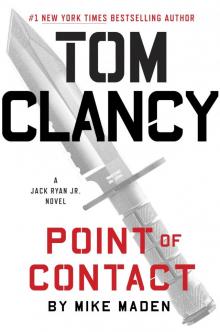 Point of Contact
 Operation Barracuda (2005)
 Choke Point
 Power and Empire
 Every Man a Tiger: The Gulf War Air Campaign
 Endgame (1998)
 EndWar: The Missing
 Splinter Cell (2004)
 The Great Race
 True Faith and Allegiance
 Deathworld
 Ghost Recon (2008)
 Duel Identity
 Line of Control o-8
 The Hunt for Red October jr-3
 Hidden Agendas nf-2
 Acts of War oc-4
 Ruthless.Com pp-2
 Night Moves
 The Hounds of Rome - Mystery of a Fugitive Priest
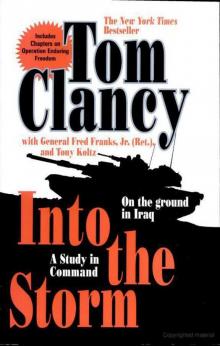 Into the Storm: On the Ground in Iraq sic-1
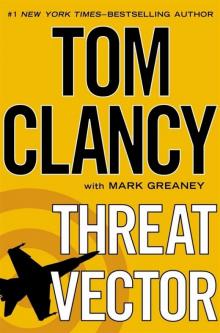 Threat Vector jrj-4
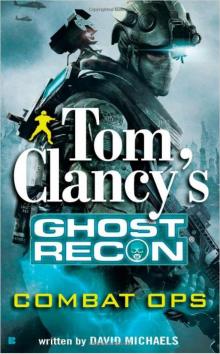 Combat Ops gr-2
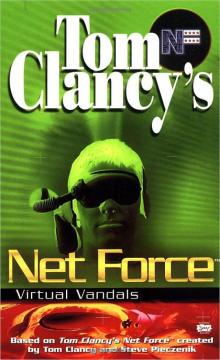 Virtual Vandals nfe-1
 Runaways nfe-16
 Marine: A Guided Tour of a Marine Expeditionary Unit tcml-4
 Shadow Warriors: Inside the Special Forces sic-3
 Jack Ryan Books 1-6
 Cold Case nfe-15
 Changing of the Guard nf-8
 Splinter Cell sc-1
 Battle Ready sic-4
 The Bear and the Dragon jrao-11
 Fighter Wing: A Guided Tour of an Air Force Combat Wing tcml-3
 Patriot Games jr-1
 Jack Ryan Books 7-12
 Mission of Honor o-9
 Private Lives nfe-9
 Operation Barracuda sc-2
 Cold War pp-5
 Point of Impact nf-5
 Red Rabbit jr-9
 The Deadliest Game nfe-2
 Springboard nf-9
 Safe House nfe-10
 EndWar e-1
 Duel Identity nfe-12
 Deathworld nfe-13
 Politika pp-1
 Rainbow Six jr-9
 Tom Clancy's Power Plays 1 - 4
 Endgame sc-6
 Executive Orders jr-7
 Net Force nf-1
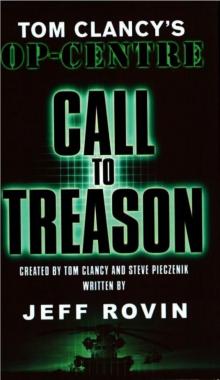 Call to Treason o-11
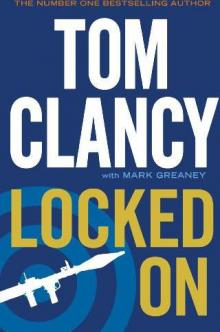 Locked On jrj-3
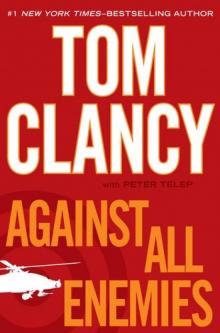 Against All Enemies
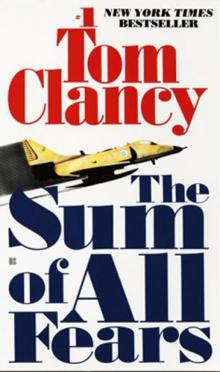 The Sum of All Fears jr-7
 Sea of Fire o-10
 Fallout sc-4
 Balance of Power o-5
 Shadow Watch pp-3
 State of War nf-7
 Wild Card pp-8
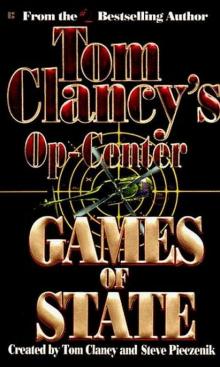 Games of State o-3
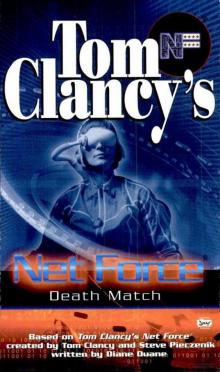 Death Match nfe-18
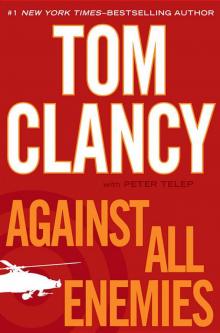 Against All Enemies mm-1
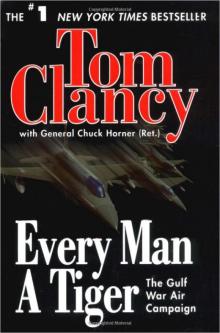 Every Man a Tiger: The Gulf War Air Campaign sic-2
 Cybernation nf-6
 Support and Defend
 Night Moves nf-3
 SSN
SSN Cutting Edge pp-6
 The Cardinal of the Kremlin jrao-5
 War of Eagles o-12
 Op-Center o-1
 Mirror Image o-2
 The Archimedes Effect nf-10
 Teeth of the Tiger jrj-1
 Bio-Strike pp-4
 State of Siege o-6
 Debt of Honor jr-6
 Zero Hour pp-7
 Ghost Recon gr-1
 Command Authority jr-10
 Tom Clancy's Power Plays 5 - 8
 Checkmate sc-3
 Breaking Point nf-4
 Gameprey nfe-11
 The Hunted e-2
 Hidden Agendas
 Divide and Conquer o-7