
- Home
- Tom Clancy
Battle Ready Page 40
Battle Ready Read online
Page 40
On a visit to Nairobi on the twenty-ninth of August, I promised Ambassador Bushnell that our FAST security forces would not leave until a new embassy was established—work that could not be completed for several months. I was therefore shocked a short time later when the Pentagon started pressuring me to withdraw the Marines before a new, more secure location for the embassy had been acquired.
According to the Pentagon, keeping the Marines there was too expensive, and security at the embassy was a State Department problem anyhow. “We did our part. Now it’s their business.”
“We can’t pull out,” I told them. “There is no way, shape, or form we can leave Americans exposed and in jeopardy out there.”
“Well, that’s the State Department’s problem,” the Pentagon kept saying. “They should be taking care of their people. Not us.”
I wasn’t going to let interagency bickering get in the way of protecting Americans. So I got tough. “Bullshit,” I said. “I’m not going to leave Americans in danger. Those Marines are going to stay out there until they get a suitable place to move the American embassy. I’m going to protect the Americans where they live and work. They’re still vulnerable.”
I got a lot of mumbling and grumbling from the Pentagon, but no one was going to challenge me on this.
BY EARLY September, the crisis between Ethiopia and Eritrea had grown even more alarming. It looked like war was soon coming to the Horn of Africa. In an effort to ease tensions and find a peaceful solution to the crisis, the President had designated former National Security Adviser Tony Lake to be a special envoy; and I was tasked to work with him. This effort became known as “the Tony-Tony Strategy.”
I traveled to Ethiopia and Eritrea during the first week of September. In meetings over several days with Prime Minister Meles and General Tsadkan of Ethiopia and President Isaias and General Shebat of Eritrea, I tried to convince everyone that a war over Badime—a desolate and barren patch of ground on the common border—was senseless and would lead to a needless bloodbath. Everyone listened politely, but neither side was willing to compromise. It was clear they were already committed to military action. I returned to the States extremely discouraged, convinced a bloody war was approaching.
Still, I had to keep trying to prevent it.
LATER IN September, when I made my first visit to the Central Asian states, I found all these societies in a state of post-Soviet shock. After seventy years of communism, Kazakhs, Uzbeks, Kirghiz, Tajiks, Turkomans, and the other ethnic groups in what had once been the southern parts of the USSR had significant economic, security, political, and social problems. Now that the communist weight had been lifted from their backs, they were trying to figure out their true identity and search for the best way forward. Naturally, each looked at our new U.S. involvement as a chance to gain the support they needed to make necessary changes. And, naturally, the U.S. was once again unwilling to invest in this new region of engagement.
But the U.S. wasn’t the only barrier to progress. Each state had its own set of problems and view of the way ahead; and there was little interest in the collective, regional approach that we preferred. Thus it was clear to me that we had to begin with bilateral arrangements.
For starters, their militaries had a dire need to reform the old Soviet system, while their security concerns about the threats (extremism, drugs, and crime, primarily coming out of Afghanistan) were real. Once again, we’d be creating an engagement program with few resources, but I was determined to work with what we had. These were frontline states, extremely vulnerable to the growing forces of extremism and chaos in South Asia. It was becoming ever clearer that these threats were not just directed at them; they were also directed at us. We had to help them.
I had begun to hear the same warning from all the leaders in the region—from President Moi of Kenya to President Karamov of Uzbekistan. They were all alarmed over the spreading menace of religious extremism and terrorist activities.
Nineteen ninety-eight marked a major transition in the institutional nature of terrorism. Before 1998, terrorist bands tended to be small, disparate, and haphazardly managed . . . or else run by charismatic leaders. They were more likely to be gangs with gripes than organizations with plans, programs, and strategies.
Al Qaeda80 changed all that.
The genius of Al Qaeda was to pull the disparate terrorist groups together, create a network to link them all, and provide the resources, training, command and control, and global reach to make this threat international. Al Qaeda had created what was in effect a virtual state whose base was its global network. Each part of the network was relatively weak, insignificant, and vulnerable; but because of the invisibility and security of the links, the threat from the network had soon reached an unprecedented level.
This was far from the threat of world annihilation that we had endured for the nearly fifty years of the Cold War; yet the dangers from an Al Qaeda allowed to grow unchecked were far from small.
IN CONNECTION with an October 21 trip to Washington for Senate testimony, I was asked by the DOD public relations office to hold a press conference at a Defense Writers’ Group breakfast.
During the session, I took questions about some exiled, London-based Iraqi opposition groups that had become the apple of Congress’s eye. The most prominent of these, the Iraqi National Congress, was led by Ahmed Chalabi. Chalabi had conned several senior people into believing that he could spark a guerrilla movement that would sweep Saddam Hussein and the Ba’athists from power—if only he had a lot of money and a little specialoperations and air support. I thought this idea was totally mad (our intelligence had reported that nothing the INC said was trustworthy and none of their plans were viable).
The October press conference was not my first encounter with this idiocy. On the twenty-sixth of March, I had traveled to Washington for my annual congressional testimony.
CINCs are required to give annual testimony before the Senate Armed Services Committee, House Armed Services Committee, and House Appropriations Committee,81 but are often also called during the year to give testimony on specific issues as they come up. At our annual testimony, we’d generally provide a status of our command and region and respond to questions. Most questions related to pet programs or issues that individual legislators wanted to promote or challenge; but some made a political point about the administration’s policies.
The issue at the March sessions was the administration’s policy in Iraq. Congress was brewing its own strategy, cooked up by a couple of Senate staffers, promoting the Iraqi National Congress and Chalabi’s guerrilla plans. I testified then that there was no chance that this operation could succeed. Saddam was too firmly entrenched to be dislodged by a handful of guerrilla bands, and Chalabi’s organization was a sham.
Naturally, my reluctance to get on board a boat I didn’t think would float did not endear me to Chalabi’s backers, many of whom, such as Senator John McCain, were powerful in Washington. And when I offered these views, I could tell Defense Secretary Cohen was not comfortable. Though the Clinton administration was extremely leery about dealing with Chalabi, any plan that promised to get rid of Saddam played in the media like motherhood and free speech, so the administration was not eager to seem to oppose it. That evening, out on the steps of the Capitol, Secretary Cohen told me to stick to military execution of policy and stay out of policy development. The rebuke was polite, but I got the message.
Congress had passed the Iraqi Liberation Act, which applied $97 million to Iraqi opposition groups, including Chalabi’s.
The administration still did not want to touch this issue. But they had no intention of spending the money on the Iraqi opposition (except for minor administrative support). They were not about to actually buy them weapons.
But by October the two Senate staffers I’d run into in March, now working with a retired Army general, had actually come up with a crazy plan to arm the “military branches” of these dissidents and insert them into Iraq with promi
ses from us of air cover and special forces support. It was a recipe for disaster, which I referred to at the press conference as “the Bay of Goats,” adding further insult by calling the exiles “Gucci Guerrillas.”
These comments caused a furor, and during my Senate testimony later that day I faced several angry Senators who supported this ludicrous proposal.
Though I was severely chewed out by my bosses afterward, I received hundreds of letters and calls, and several articles were written, in support of my position.
The story does not end there. Washington is a vindictive town, and the two staffers swore revenge. They did not take it out on me, but on my political adviser, Larry Pope. When Pope was nominated for Ambassador to Kuwait, they were able to block a Senate vote on it. This petty act against a man who had nothing to do with my opinions was typical of the Washington politics that sickened me.
NINETEEN NINETY-EIGHT ended with a bang with Desert Fox.
I knew we’d get no respite from the constant high-level tempo of operations in 1999.
IN EARLY JANUARY, the administration directed Tony Lake to make another effort (which we supported) to broker peace in the looming Ethiopia-Eritrea war; yet I knew we were not going to stop the impending fight. When the war actually began in the spring of 1999, we conducted an evacuation of American citizens (called “Operation Safe Departure”).
The war was bloody. World War One-style trench warfare and massive frontal attacks caused thousands of deaths.
After an Ethiopian victory at Badime (by which time the two belligerents had exhausted themselves on the battlefield), we worked with Tony Lake and the State Department to establish a peacekeeping force there. By the end of the year, a UN force provided a boundary demarcation team and peacekeepers to try to help resolve the dispute.
ON THE twenty-first of April, I traveled to Pakistan for several days of meetings with the new chief of staff, General Pervez Musharraf. The two of us connected quickly and easily. He was bright, sincere, and personable. A fervent nationalist who nevertheless leaned toward the West, he was as appalled as General Karamat over the ever-worsening corruption within the civilian government. He also understood the various, powerful Islamist currents running through his country, and saw them as the threats they were to bringing his country into the twenty-first century; yet he also understood that his country would never modernize and solve its myriad ills without the emergence of some kind of religious accommodation, and hopefully religious consensus.
It was a great meeting, despite the chill cast by our sanctions. As I was leaving, we both agreed to stay in close touch (we exchanged our home telephone numbers). Our friendship would later prove to be enormously valuable to both our countries.
IN MAY, Pakistani forces made a deep incursion into an area called Kargil, on the Indian side of the Line of Control.
Though there was normally “fighting” near the Line of Control, the area for a long time had been quite stable. There’d be probes and shooting during the good months of the year, but nothing ever changed much; and in wintertime, everybody would pull back down into the valleys, and the two sides would create a “no-man’s-land.” As spring came, they’d go back up into their positions.
Every so often, somebody on one side would be a little late getting up to their spring position, and the other side could grab an advantage of a kilometer or so. It was like “Aha, I’ve gotcha!” on a tactical level. But it didn’t really change things.
This time, however, the Pakistanis waylaid the Indians and penetrated all the way to Kargil. This was such a deep, significant penetration that it wasn’t tactical; it threatened Indian lines of communication and support up to Siachen glacier.
The Indians came back with a vengeance. There were exchanges of fire, there was a mobilization of forces, there were bombing attacks, planes were shot down. Then the two sides started to mobilize all their forces all along the line; and it was beginning to look like the opening moves of a larger war. It got alarming.
I was therefore directed by the administration to head a presidential mission to Pakistan to convince Prime Minister Sharif and General Musharraf to withdraw their forces from Kargil.
I met with the Pakistani leaders in Islamabad on June 24 and 25 and put forth a simple rationale for withdrawing: “If you don’t pull back, you’re going to bring war and nuclear annihilation down on your country. That’s going to be very bad news for everybody.” Nobody actually quarreled with this rationale. The problem for the Pakistani leadership was the apparent national loss of face. Backing down and pulling back to the Line of Control looked like political suicide. We needed to come up with a face-saving way out of this mess. What we were able to offer was a meeting with President Clinton, which would end the isolation that had long been the state of affairs between our two countries, but we would announce the meeting only after a withdrawal of forces.
That got Musharraf’s attention; and he encouraged Prime Minister Sharif to hear me out.
Sharif was reluctant to withdraw before the meeting with Clinton was announced (again, his problem was maintaining face); but after I insisted, he finally came around and he ordered the withdrawal. We set up a meeting with Clinton in July.
IN OCTOBER 1999, the tension between the civilian and military leadership of Pakistan finally came to a head. The government was freely elected but outrageously corrupt. The military found itself between a rock and a hard place. If they let the situation continue, the rot could grow bad enough that the country would collapse—a very real possibility. But there was no way to change this situation according to the normal liberal democratic rules.
Sharif set in motion his own downfall by trying to fire General Musharraf, while Musharraf was out of the country, and to put the chief of intelligence in his place. He had originally given Musharraf the job under the misperception that Musharraf would be easy to control. He had not reckoned on the general’s integrity.
In response to Sharif’s move, the Pakistani army executed a coup.
While the coup was moving to its climax, Musharraf was flying home; and for him, success was a very near thing. His aircraft came back into the country low on fuel; but the airports, still under the control of Sharif’s forces, were closed to him. At the last possible moment, forces friendly to Musharraf took over the airport and the general landed.
Prime Minister Sharif was soon placed under arrest, and Musharraf declared his intent to clean up governmental corruption and install true democracy.
The coup did not play well in Washington, and I was ordered to cease communications with General Musharraf. Though I thought the order was stupid, I complied.
EVERY OTHER YEAR, we conduct a joint exercise with Egypt called “Bright Star.” It is the largest military exercise in the world.82
In November, I was in a reviewing stand with Secretary Cohen, participating in Bright Star, when my communicator announced that a call from General Musharraf had been patched through to my satellite phone (which was with me at all times).
I turned to Cohen. “What do you want me to do?” I asked.
“Take the call, but don’t make any commitments,” he said.
It was a personal call between friends, Musharraf explained (though, of course, we both knew that any conversation we had would have wider ramifications). He wanted me to know what had led to the coup and why he and the other military leaders had had no choice other than the one they took.
The point he made then was a powerful one: “Democracy and the ballot are both a sham when any government that results can offer everything they control up for sale. We’ve had a democracy of form, and not a democracy of substance. I want democracy in substance, I’ll work for that, no matter what it costs me.
“And there’s one more thing I have to make clear,” he told me. “I don’t care what most others think about my motivations or intentions; but it’s important to me that you know what they are.”
I thanked him for his candor, and wished him well.
&nbs
p; When I briefed Cohen on the call, I made it clear that it was more important than ever to stay connected to Pakistan. He understood what I was saying, but he didn’t think Washington would be convinced.
IN DECEMBER, Jordanian intelligence uncovered a massive plot to kill American tourists at the turn-of-millennium celebrations in Jordan and throughout the Middle East. The captured terrorists, who had links to Osama bin Laden, revealed that their immediate leaders were in Pakistan.
Calls soon came from the State Department and National Security Council: “Please call Musharraf and ask him to help.”
In response to my requests, Musharraf arrested the terrorists (and gave us access to them and to their confiscated computer disks) . . . and threw in several other favors.
“Now do something for Musharraf,” I told Washington. “Or at least let us reconnect.”
The answer was no.
I called Musharraf and told him how disappointed I was. “I know that cooperation isn’t popular in some circles of your own government and people, as well,” I explained. “I know what courage it took to do what you did for us. So it’s doubly embarrassing for me that I can’t give you anything in return.”
“I don’t want or expect anything for what I’ve done,” Musharraf replied. “Tony, I did it because it was the right thing to do.”
ON MY final trips to the region in the spring and summer of 2000, I was deeply moved by the reception I received from my many friends. Their expressions of appreciation for what we had done and the relationships we had built made me feel we were well on our way to stabilizing this volatile part of the world. I knew, however, that we had a long way to go. This was a dangerous neighborhood. The region needed to make many political, social, economic, and security reforms, but it needed time, space, and support (and, in some cases, prodding) to get these done. I felt we could help effect these changes by providing this help.
 Changing of the Guard
 Clear and Present Danger
 Hounds of Rome
 Breaking Point
 Tom Clancy's Jack Ryan Books 7-12
 Full Force and Effect
 The Archimedes Effect
 Combat Ops
 Into the Storm: On the Ground in Iraq
 Under Fire
 Point of Impact
 Red Rabbit
 Rainbow Six
 The Hunt for Red October
 The Teeth of the Tiger
 Conviction (2009)
 Battle Ready
 Patriot Games
 The Sum of All Fears
 Fallout (2007)
 Red Storm Rising
 The Cardinal of the Kremlin
 Executive Orders
 Lincoln, the unknown
 Threat Vector
 The Hunted
 Shadow Warriors: Inside the Special Forces
 End Game
 Special Forces: A Guided Tour of U.S. Army Special Forces
 Locked On
 Line of Sight
 Tom Clancy Enemy Contact - Mike Maden
 Fighter Wing: A Guided Tour of an Air Force Combat Wing
 Springboard
 Line of Sight - Mike Maden
 EndWar
 Dead or Alive
 Tom Clancy Support and Defend
 Checkmate
 Command Authority
 Carrier: A Guided Tour of an Aircraft Carrier
 Blacklist Aftermath
 Marine: A Guided Tour of a Marine Expeditionary Unit
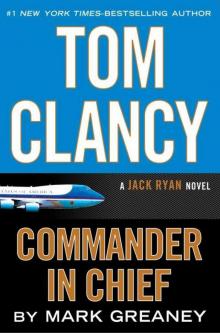 Commander-In-Chief
 Armored Cav: A Guided Tour of an Armored Cavalry Regiment
 Tom Clancy's Jack Ryan Books 1-6
 The Ultimate Escape
 Airborne: A Guided Tour of an Airborne Task Force
 Debt of Honor
 Cyberspy
 Point of Contact
 Operation Barracuda (2005)
 Choke Point
 Power and Empire
 Every Man a Tiger: The Gulf War Air Campaign
 Endgame (1998)
 EndWar: The Missing
 Splinter Cell (2004)
 The Great Race
 True Faith and Allegiance
 Deathworld
 Ghost Recon (2008)
 Duel Identity
 Line of Control o-8
 The Hunt for Red October jr-3
 Hidden Agendas nf-2
 Acts of War oc-4
 Ruthless.Com pp-2
 Night Moves
 The Hounds of Rome - Mystery of a Fugitive Priest
 Into the Storm: On the Ground in Iraq sic-1
 Threat Vector jrj-4
 Combat Ops gr-2
 Virtual Vandals nfe-1
 Runaways nfe-16
 Marine: A Guided Tour of a Marine Expeditionary Unit tcml-4
 Shadow Warriors: Inside the Special Forces sic-3
 Jack Ryan Books 1-6
 Cold Case nfe-15
 Changing of the Guard nf-8
 Splinter Cell sc-1
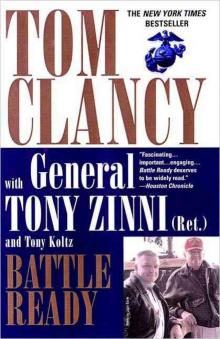 Battle Ready sic-4
 The Bear and the Dragon jrao-11
 Fighter Wing: A Guided Tour of an Air Force Combat Wing tcml-3
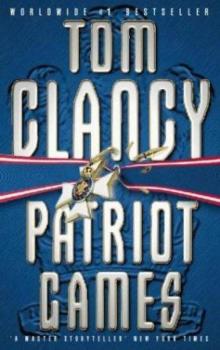 Patriot Games jr-1
 Jack Ryan Books 7-12
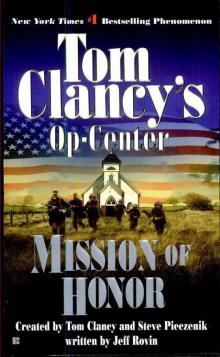 Mission of Honor o-9
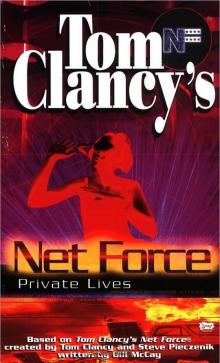 Private Lives nfe-9
 Operation Barracuda sc-2
 Cold War pp-5
 Point of Impact nf-5
 Red Rabbit jr-9
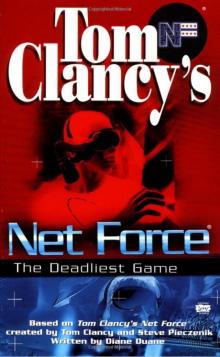 The Deadliest Game nfe-2
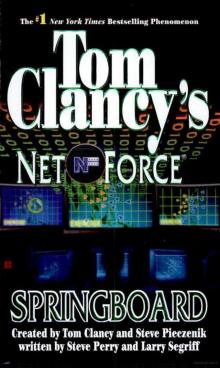 Springboard nf-9
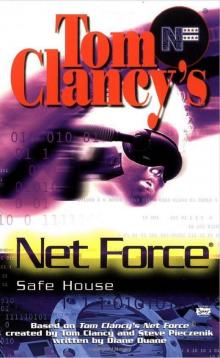 Safe House nfe-10
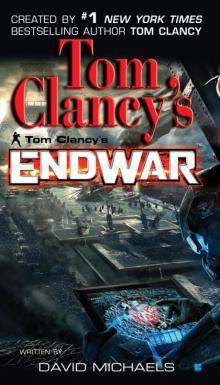 EndWar e-1
 Duel Identity nfe-12
 Deathworld nfe-13
 Politika pp-1
 Rainbow Six jr-9
 Tom Clancy's Power Plays 1 - 4
 Endgame sc-6
 Executive Orders jr-7
 Net Force nf-1
 Call to Treason o-11
 Locked On jrj-3
 Against All Enemies
 The Sum of All Fears jr-7
 Sea of Fire o-10
 Fallout sc-4
 Balance of Power o-5
 Shadow Watch pp-3
 State of War nf-7
 Wild Card pp-8
 Games of State o-3
 Death Match nfe-18
 Against All Enemies mm-1
 Every Man a Tiger: The Gulf War Air Campaign sic-2
 Cybernation nf-6
 Support and Defend
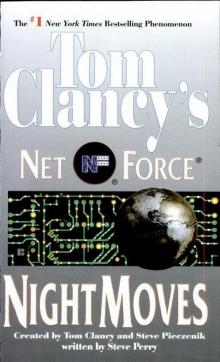 Night Moves nf-3
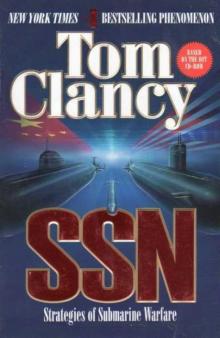 SSN
SSN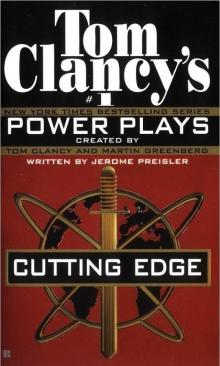 Cutting Edge pp-6
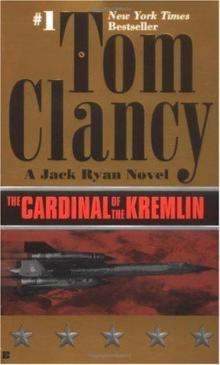 The Cardinal of the Kremlin jrao-5
 War of Eagles o-12
 Op-Center o-1
 Mirror Image o-2
 The Archimedes Effect nf-10
 Teeth of the Tiger jrj-1
 Bio-Strike pp-4
 State of Siege o-6
 Debt of Honor jr-6
 Zero Hour pp-7
 Ghost Recon gr-1
 Command Authority jr-10
 Tom Clancy's Power Plays 5 - 8
 Checkmate sc-3
 Breaking Point nf-4
 Gameprey nfe-11
 The Hunted e-2
 Hidden Agendas
 Divide and Conquer o-7