
- Home
- Tom Clancy
Executive Orders Page 34
Executive Orders Read online
Page 34
“Who’s running it?” Ryan remembered that Hanson, good diplomatic technician though he might have been, had never listened all that well to anybody.
“Mr. Murray had designated OPR to continue the investigation independently of his office. That means I’m out, too, because I have reported directly to you in the past. This will be my last direct involvement with the case.”
“Strictly by the book?”
“Mr. President, it has to be that way,” the inspector said with a nod. “They’ll have additional help from the Legal Counsel Division. Those are agents with law degrees who act as in-house legal beagles. They’re good troops.” O’Day thought for a moment. “Who’s been in and out of the Vice President’s office?”
“Here, you mean?”
“Yes, sir.”
Andrea Price answered that one: “Nobody lately. It’s been unused since he left. His secretary went with him and—”
“You might want to have someone check the typewriter. If it uses a carbon-tape ribbon—”
“Right!” She almost moved right out of the Oval Office. “Wait. Have your people—”
“I’ll make the call,” O’Day assured her. “Sorry, Mr. President. I should have thought of that sooner. Please seal the office for us?”
“Done,” Price assured him.
THE NOISE WAS unbearable. The monkeys were social animals, who customarily lived in “troops” of up to eighty individuals that populated mainly the margins of forests on the edge of the broad savannas, the easier to come down from their trees and raid the surrounding open land for food. They had learned in the past hundred years to raid farms, which was easier and safer than what Nature had programmed into their behavior, because the humans who operated the farms typically controlled the predators which ate the monkeys. An African green was a tasty morsel for a leopard or hyena, but so was a calf, and farmers had to protect those. What resulted was a curious bit of ecological chaos. To protect livestock, the farmers, legally or not, eliminated the predators. That allowed the monkey population to expand rapidly, and the hungry African greens would then attack the cereal and other crops which fed both the farmers and their livestock. As a complication, the monkeys also ate insects which preyed on the crops as well, leading local ecologists to suggest that eliminating the monkeys was bad for the ecology. For the farmers it was much simpler. If it ate their livestock, it was killed. If it ate their crops, it was killed also. Bugs might not be large enough to see, but monkeys were, and so few farmers objected when the trappers came.
Of the family cercopithecus, the African green has yellow whiskers and a gold-green back. It can live to thirty years of age—more likely in comfortable captivity than in the predator-infested wild—and has a lively social life. The troops are made of female families, with male monkeys joining the troops individually for periods of a few weeks or months before moving on. An abundance of females in mating season allows a number of males cooperatively to enjoy the situation, but that was not the case in the aircraft. Rather, the cages were stacked like a truckload of chicken coops on the way to market. Some females were in season but totally inaccessible, frustrating the would-be suitors. Males stacked next to the cages of other males hissed, clawed, and spat at their unwilling neighbors, all the more unhappy that their captors had not noted the simple fact that same-sized cages were used to imprison different-sized monkeys—the male African green is fully double the size of the female—and cramping males who could smell that most welcome of natural signals, so near and yet so far. Added to the unfamiliar smells of the aircraft and the absence of food and water, the crowding caused nothing short of a simian riot, and since the issue could not be resolved by combat, all that resulted was a collective screech of rage from hundreds of individuals which far outstripped the sound of the JT-8 engines driving the aircraft east over the Indian Ocean.
Forward, the flight crew had their cabin door firmly shut and their headphones clamped tightly over their ears. That attenuated the sound, but not the fetid smell which the aircraft’s recirculation systems cycled back and forth, both further enraging the cargo and sickening the crew.
The pilot, normally an eloquent man with his invective, had run out of curses and had tired of entreating Allah to expunge these horrid little creatures from the face of the earth. In a zoo, perhaps, he would have pointed to the long-tailed creatures, and his twin sons would have smiled and perhaps tossed some peanuts to their amusing captives. No more. With his tolerance gone, the pilot reached for the emergency oxygen mask and switched the flow on, wishing then he might blow open the cargo doors, depressurize the aircraft and thus both extinguish the monkeys and vent the dreadful smell. He would have felt better had he known what the monkeys knew. Something evil was afoot for them.
BADRAYN MET THEM again in a communications bunker. It didn’t give him the sense of security that all the massed concrete might have. The only reason this one still stood was that it was concealed under the falsework of an industrial building—a bookbindery, in fact, which actually turned out a few books. This one and a handful of others had survived the war with America only because the Americans’ intelligence had been faulty. Two “smart bombs” had targeted a building directly across the road. You could still see the crater where the Americans had thought this structure to be. There was a lesson in that, Badrayn thought, still waiting. You had to see it, really, to believe it. It wasn’t the same to look at a TV screen or hear about it. There were five meters of rebarred concrete over his head. Five meters. It was solid, built under the supervision of well-paid German engineers. You could still see the impression of the plywood sheets which had held the wet concrete in place. Not a crack to be seen—and yet the only reason this place still stood was because the Americans had bombed the wrong side of the street. Such was the power of modern weapons, and though Ali Badrayn had existed in the world of arms and struggle for all of his life, this was the first time he fully appreciated that fact.
They were good hosts. He had a full colonel to look after him. Two sergeants fetched snacks and drinks. He’d watched the funeral on the TV. It was as predictable as one of the American police programs that blanketed the world. You always knew how it would end. The Iraqis, like most people in the region, were a passionate race, particularly when assembled in large numbers and encouraged to make the proper noises. They were easily led and easily moved, and Badrayn knew that it didn’t always matter by whom. Besides, how much of it had been genuine? The informers were still out there to note who didn’t cheer or grieve. The security apparatus which had failed the dead President still operated, and everyone knew it. And so little of the emotion which had flowed so freely on the screen and across the broad plazas was real. He chuckled to himself. Like a woman, Badrayn told himself, feigning her moment of supreme pleasure. The question was, would the men who so often took their pleasure without giving it notice the difference?
They arrived singly, lest a pair or small group travel together and discuss things which the entire assembly needed to hear as one. A fine wooden cabinet was opened to reveal bottles and glasses, and the laws of Islam were violated. Badrayn didn’t mind. He had a glass of vodka, for which he’d acquired the taste twenty years earlier in Moscow, then the capital of a country now vanished.
They were surprisingly quiet for such powerful men, all the more so for people attending the wake of a man they’d never loved. They sipped their drinks—mainly scotch—and again they mainly looked at one another. On the television, still switched on, the local station was replaying the funeral procession, the announcer extolling the surpassing virtue of the fallen leader. The generals looked on and listened, but the look on their faces was not one of sadness, but fear. Their world had come to an end. They were not moved by the shouts of the citizens or the words of the news commentator. They all knew better.
The last of them arrived. He was the intelligence chief who’d met Badrayn earlier in the day, fresh from having stopped in at his headquarters. The others looked to him, a
nd he answered without the necessity of hearing the question.
“Everything is quiet, my friends.”
For now. That terse observation didn’t have to be spoken either.
Badrayn could have spoken, but didn’t. His was an eloquent voice. Over the years he’d had to motivate many persons, and he knew how, but this was a time when silence was the most powerful statement of all. He merely looked at them, and waited, knowing that his eyes spoke far more loudly than any voice could have done.
“I don’t like this,” one of them said finally. Not a single face changed. Hardly surprising. None of them liked it. The one who spoke merely affirmed what all thought, and showed himself in doing so to be the weakest of the group.
“How do we know we can trust your master?” the head of the Guards asked.
“He gives you his word in the name of God,” Badrayn replied, setting down his glass. “If you wish, a delegation of your number may fly to see him. In that case, I will remain here as your hostage. But if you wish that, it must be done quickly.”
They all knew that, too. The thing they feared was as likely to happen before their possible departure as after. There followed another period of silence. They were scarcely even sipping at their drinks now. Badrayn could read their faces. They all wanted someone else to make a stand, and then that stand could be agreed to or disputed, and in the process the group would reach a collective position with which all would probably abide, though there might be a faction of two or three to consider an alternative course of action. That depended on which of them placed his life on the scales and tried to weigh it against an unknown future. He waited vainly to see who would do that. Finally, one of them spoke.
“I was late marrying,” the air force chief said. His twenties and thirties had been the life of a fighter pilot on the ground if not quite in the air. “I have young children.” He paused and looked around. “I think we all know the possible—the likely—outcome for our families should things ... develop unfavorably.” It was a dignified gambit, Badrayn thought. They could not be cowardly. They were soldiers, after all.
Daryaei’s promise in God’s name was not overly convincing to them. It had been a very long time since any of them had visited a mosque for any purpose other than to be photographed there in his simulated devotions, and though it was very different for their enemy, trust in another’s religion begins in one’s own heart.
“I presume that finances are not at issue here,” Badrayn said, both to be sure that it was not, and to make them examine that option themselves. A few heads turned with looks that were close to amusement, and the question was answered. Though official Iraqi accounts had long been frozen, there were other such accounts which had not. The nationality of a bank account was, after all, fungible, all the more so with the size of the account. Each of these men, Badrayn thought, had personal access to nine figures of some hard currency, probably dollars or pounds, and this was not the time to worry about whose money it should have been.
The next question was, Where could they go, and how could they get there safely? Badrayn could see that in their faces, and yet he could do nothing at the moment. The irony of the situation, which only he was in a position to appreciate, was that the enemy whom they feared and whose word they distrusted wished nothing more than to allay their fear and keep his word. But Ali knew him to be a surpassingly patient man. Else he would not have been here at all.
“YOU’RE QUITE SURE?”
“The situation is nearly ideal,” Daryaei’s visitor told him, explaining further.
Even for a religious man who believed in the Will of God, the confluence of events was just too good to be true, and yet it was or appeared to be so.
“And?”
“And we are proceeding according to the plan.”
“Excellent.” It wasn’t. Daryaei would have much preferred to deal with each in turn, the better to concentrate his formidable intellect on the three developing situations one at a time, but this was not always possible, and perhaps that was the sign. In any case, he had no choice. How strange that he should feel trapped by events resulting from plans he himself had set in motion.
THE HARDEST PART was dealing with his World Health Organization colleagues. That was only possible because the news was good so far. Benedict Mkusa, the “Index Patient” or “Patient Zero,” depending on one’s favored terminology, was dead, and his body was destroyed. A team of fifteen had scoured the family’s neighborhood and found nothing as yet. The critical period had yet to run out—Ebola Zaire had a normal incubation period of four to ten days, though there were extreme cases as brief as two days and as long as nineteen but the only other case was before his eyes. It turned out that Mkusa was a budding naturalist, who spent much of his free time in the bush, and so now there was a search team in the tropical forest, catching rodents and bats and monkeys to make yet another attempt to discover the “host,” or carrier of the deadly virus. But above all they hoped that, for once, fortune had smiled on them. The Index Patient had come directly to hospital because of his family status. His parents, educated and affluent, had let health-care professionals treat the boy instead of doing so themselves, and in that they had probably saved their own lives, though even now they were waiting out the incubation period with what had to be stark terror that surpassed even their grief at the loss of a son. Every day they had their blood drawn for the standard IFA and antigen tests, but the tests could be misleading, as some insensitive medico had foolishly told them. Regardless, the WHO team was allowing itself to hope that this outbreak would stop at two patient-victims, and because of that, they were willing to consider what Dr. Moudi proposed to do.
There were objections, of course. The local Zairean physicians wanted to treat her here. There was merit to that. They had more experience with Ebola than anybody, though it had done little good to anyone, and the WHO team was reluctant for political reasons to insult their colleagues. There had been some unfortunate incidents before, with the natural hauteur of the Europeans resented by the local doctors. There was justice on both sides. The quality of the African doctors was uneven. Some were excellent, some terrible, and some ordinary. The telling argument was that Rousseau in Paris was a genuine hero to the international community, a gifted scientist and a ferociously dedicated clinician who refused to accept the fact that viral diseases could not be treated effectively. Rousseau, in the tradition of Pasteur before him, was determined to break that rule. He’d tried ribavirin and interferon as treatments for Ebola, without positive result. His latest theoretical gambit was dramatic and likely to be ineffective, but it had shown some small promise in monkey studies, and he wanted to try it on a human patient under carefully controlled conditions. Though his proposed method of treatment was anything but practical for real clinical application, you had to start somewhere.
The deciding factor, predictably, was the identity of the patient. Many of the WHO team knew her from the last Ebola outbreak at Kikwit. Sister Jean Baptiste had flown to that town to supervise the local nurses, and doctors no less than others could be moved by familiarity with those under their care. Finally, it was agreed that, yes, Dr. Moudi could transport the patient.
The mechanics of the transfer were difficult enough. They used a truck rather than an ambulance, because a truck would be easier to scrub down afterward. The patient was lifted on a plastic sheet onto a gurney and wheeled out into the corridor. That was cleared of other people, and as Moudi and Sister Maria Magdalena wheeled the patient toward the far door, a group of technicians dressed in plastic “space suits” sprayed the floor and walls, the very air itself, with disinfectant in a smelly man-made chemical fog that trailed the procession like exhaust from an overaged car.
The patient was heavily sedated and firmly restrained. Her body was cocooned to prevent the release of virus-rich bleeding. The plastic sheet under her had been sprayed with the same neutralizing chemicals, so that leaks would immediately find a very adverse environment for the virus partic
les they carried. As Moudi pushed the gurney from behind, he marveled at his own madness, taking such chances with something as deadly as this. Jean Baptiste’s face, at least, was placid from the dangerously high dosage of narcotics, marked though it was with the growing petechia.
They moved outdoors onto the loading dock where supplies arrived at the hospital. The truck was there, its driver seated firmly behind the wheel and not even looking backward at them, except perhaps in the mirror. The interior of the van body had likewise been sprayed, and with the door closed and the gurney firmly locked in place, it drove off with a police escort, never exceeding thirty kilometers per hour for the short trip to the local airport. That was just as well. The sun was still high, and its heat rapidly turned the truck into a mobile oven, boiling off the protective chemicals into the enclosed space. The smell of the disinfectant came through the suit’s filtration system. Fortunately, the doctor was used to it.
The aircraft was waiting. The G-IV had arrived only two hours earlier after a direct flight from Tehran. The interior had been stripped of everything but two seats and a cot. Moudi felt the truck stop and turn and back up. Then the cargo door opened, dazzling them with the sun. Still the nurse, and still a compassionate one, Sister Maria Magdalena used her hand to shield the eyes of her colleague.
There were others there, of course. Two more nuns in protective garb were close by, and a priest, with yet more farther away. All were praying as some other lifted the patient by the plastic sheet and carried her slowly aboard the white-painted business jet. It took five careful minutes before she was firmly strapped in place, and the ground crewmen withdrew. Moudi gave his patient a careful look, checking pulse and blood pressure, the former rapid and the latter still dropping. That worried him. He needed her alive as long as possible. With that done, he waved to the flight crew and strapped into his own seat.
 Changing of the Guard
 Clear and Present Danger
 Hounds of Rome
 Breaking Point
 Tom Clancy's Jack Ryan Books 7-12
 Full Force and Effect
 The Archimedes Effect
 Combat Ops
 Into the Storm: On the Ground in Iraq
 Under Fire
 Point of Impact
 Red Rabbit
 Rainbow Six
 The Hunt for Red October
 The Teeth of the Tiger
 Conviction (2009)
 Battle Ready
 Patriot Games
 The Sum of All Fears
 Fallout (2007)
 Red Storm Rising
 The Cardinal of the Kremlin
 Executive Orders
 Lincoln, the unknown
 Threat Vector
 The Hunted
 Shadow Warriors: Inside the Special Forces
 End Game
 Special Forces: A Guided Tour of U.S. Army Special Forces
 Locked On
 Line of Sight
 Tom Clancy Enemy Contact - Mike Maden
 Fighter Wing: A Guided Tour of an Air Force Combat Wing
 Springboard
 Line of Sight - Mike Maden
 EndWar
 Dead or Alive
 Tom Clancy Support and Defend
 Checkmate
 Command Authority
 Carrier: A Guided Tour of an Aircraft Carrier
 Blacklist Aftermath
 Marine: A Guided Tour of a Marine Expeditionary Unit
 Commander-In-Chief
 Armored Cav: A Guided Tour of an Armored Cavalry Regiment
 Tom Clancy's Jack Ryan Books 1-6
 The Ultimate Escape
 Airborne: A Guided Tour of an Airborne Task Force
 Debt of Honor
 Cyberspy
 Point of Contact
 Operation Barracuda (2005)
 Choke Point
 Power and Empire
 Every Man a Tiger: The Gulf War Air Campaign
 Endgame (1998)
 EndWar: The Missing
 Splinter Cell (2004)
 The Great Race
 True Faith and Allegiance
 Deathworld
 Ghost Recon (2008)
 Duel Identity
 Line of Control o-8
 The Hunt for Red October jr-3
 Hidden Agendas nf-2
 Acts of War oc-4
 Ruthless.Com pp-2
 Night Moves
 The Hounds of Rome - Mystery of a Fugitive Priest
 Into the Storm: On the Ground in Iraq sic-1
 Threat Vector jrj-4
 Combat Ops gr-2
 Virtual Vandals nfe-1
 Runaways nfe-16
 Marine: A Guided Tour of a Marine Expeditionary Unit tcml-4
 Shadow Warriors: Inside the Special Forces sic-3
 Jack Ryan Books 1-6
 Cold Case nfe-15
 Changing of the Guard nf-8
 Splinter Cell sc-1
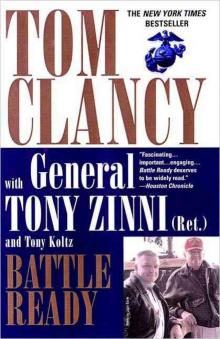 Battle Ready sic-4
 The Bear and the Dragon jrao-11
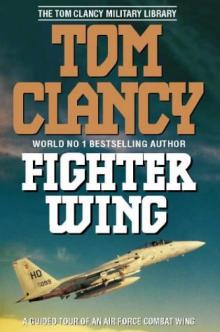 Fighter Wing: A Guided Tour of an Air Force Combat Wing tcml-3
 Patriot Games jr-1
 Jack Ryan Books 7-12
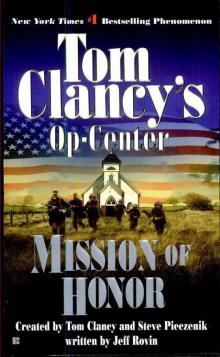 Mission of Honor o-9
 Private Lives nfe-9
 Operation Barracuda sc-2
 Cold War pp-5
 Point of Impact nf-5
 Red Rabbit jr-9
 The Deadliest Game nfe-2
 Springboard nf-9
 Safe House nfe-10
 EndWar e-1
 Duel Identity nfe-12
 Deathworld nfe-13
 Politika pp-1
 Rainbow Six jr-9
 Tom Clancy's Power Plays 1 - 4
 Endgame sc-6
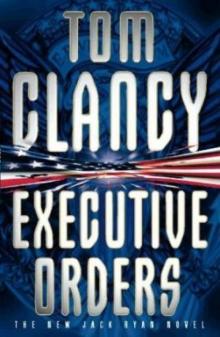 Executive Orders jr-7
 Net Force nf-1
 Call to Treason o-11
 Locked On jrj-3
 Against All Enemies
 The Sum of All Fears jr-7
 Sea of Fire o-10
 Fallout sc-4
 Balance of Power o-5
 Shadow Watch pp-3
 State of War nf-7
 Wild Card pp-8
 Games of State o-3
 Death Match nfe-18
 Against All Enemies mm-1
 Every Man a Tiger: The Gulf War Air Campaign sic-2
 Cybernation nf-6
 Support and Defend
 Night Moves nf-3
 SSN
SSN Cutting Edge pp-6
 The Cardinal of the Kremlin jrao-5
 War of Eagles o-12
 Op-Center o-1
 Mirror Image o-2
 The Archimedes Effect nf-10
 Teeth of the Tiger jrj-1
 Bio-Strike pp-4
 State of Siege o-6
 Debt of Honor jr-6
 Zero Hour pp-7
 Ghost Recon gr-1
 Command Authority jr-10
 Tom Clancy's Power Plays 5 - 8
 Checkmate sc-3
 Breaking Point nf-4
 Gameprey nfe-11
 The Hunted e-2
 Hidden Agendas
 Divide and Conquer o-7